
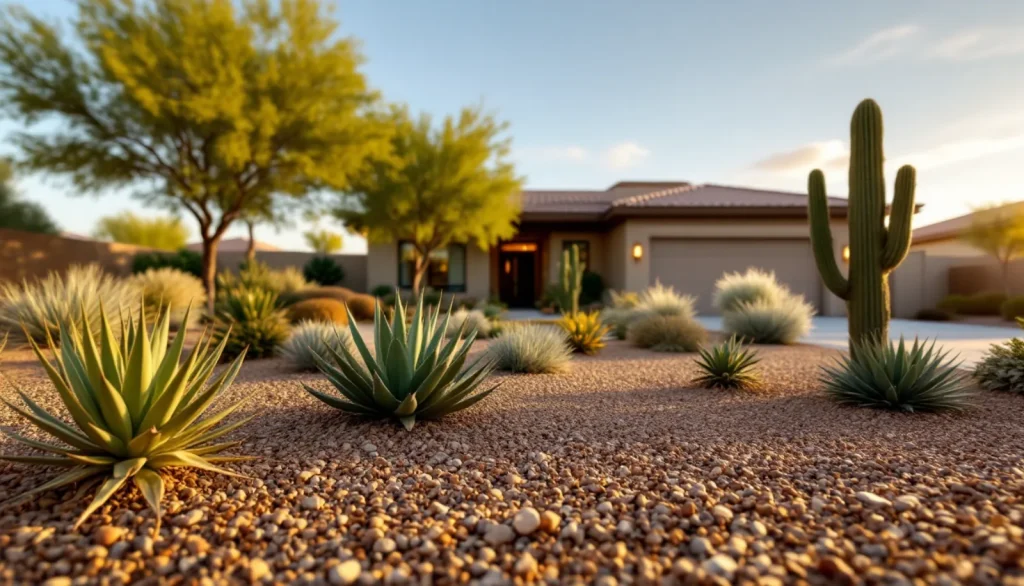
The Nevada turf replacement program run by the Southern Nevada Water Authority pays homeowners and commercial property owners $6 per square foot to tear out grass and replace it with drought-tolerant landscape, capped at 10,000 square feet per parcel. It is the most generous turf rebate in the United States, and it has converted more than 220 million square feet of Las Vegas turf to xeriscape since the program began, making the program the national template that California, Arizona, and Utah have been openly trying to copy.
The short version
- Southern Nevada Water Authority (SNWA) Water Smart Landscapes program pays $6 per square foot.
- Cap is 10,000 square feet per property per fiscal year. Large commercial sites can phase across years.
- Requires drip irrigation conversion, drought-tolerant plant palette, before and after photos, and pre-approval.
- Administered through seven SNWA wholesale members: LV Valley Water District, Henderson, North Las Vegas, Boulder City, Big Bend Water District, Clark County Water Reclamation District, and the City of Las Vegas.
- Estimated $300 million in cumulative rebates paid since 1999, with SNWA reporting roughly 55 gallons of water saved per square foot per year.
How the program works
The Water Smart Landscapes program is administered through SNWA but the rebate dollars come through the seven wholesale member agencies. A homeowner or property manager applies to the agency that bills their water service, schedules a pre-conversion site visit, gets the project pre-approved, completes the conversion, then submits before-and-after photos and an irrigation conversion certification. The agency cuts a check, typically inside 6 to 8 weeks of final approval.
The $6 per square foot rate applies to the first 10,000 square feet of turf removed per parcel per fiscal year. Above that threshold, conversions on the same parcel can continue in subsequent fiscal years. Large commercial sites, HOAs, and apartment complexes routinely phase the conversion across two or three years to stay inside the annual cap.
Eligible replacement landscaping has to meet the SNWA plant list, which is built around Mojave-adapted species. The list includes desert willow, Texas ranger, palo verde, Mexican feather grass, agave, and a long list of drought-tolerant perennials. Synthetic turf is not eligible for the rebate at the same rate, though it is permitted as a partial conversion element. Drip irrigation is mandatory for the replacement landscape, with spray heads removed entirely from the converted area.
Why this matters
Southern Nevada draws 90 percent of its water from Lake Mead. Lake Mead elevation hit its all-time low of 1,041 feet in July 2022 and has only partially recovered since. The Bureau of Reclamation declared a Tier 2a shortage that triggered Nevada’s mandatory cut to 25,000 acre-feet of Colorado River water under the 2019 Drought Contingency Plan, and that cut has held through subsequent years. Nevada’s response has been to attack outdoor water use, because roughly 60 percent of residential water use in Southern Nevada goes to landscape irrigation.
Nevada Assembly Bill 356, signed by Governor Sisolak in 2021, took the additional step of banning what the legislation calls non-functional turf in commercial and HOA settings inside the Las Vegas Valley by the end of 2026. The combination of the turf rebate and the non-functional turf ban means that the conversion is no longer optional for a wide swath of commercial sites. The rebate is the carrot. AB 356 is the stick.
For landscape operators, that creates one of the most predictable book-of-business pipelines in the country. Every commercial property, HOA, and golf course rough in the Las Vegas Valley is on the clock to either convert voluntarily under the rebate or get cited under AB 356.
By the numbers
| Item | Number |
|---|---|
| Rebate rate | $6 per square foot (first 10,000 sq ft) |
| Annual cap per parcel | 10,000 sq ft |
| Cumulative turf converted (since 1999) | ~220 million sq ft |
| Cumulative rebates paid | ~$300 million |
| Estimated water savings | ~55 gallons per sq ft per year |
| Lake Mead elevation, July 2022 low | 1,041 feet |
| Non-functional turf ban deadline | End of 2026 (Nevada AB 356) |
What landscape operators should do
Las Vegas Valley landscape contractors who have not already built a conversion practice are leaving real revenue on the table. The right shape of the business is a design-build conversion line with one of the agency-credentialed installers on staff, a drip-irrigation conversion crew, and a plant procurement relationship with one of the regional native plant nurseries. The conversion job ticket typically runs $14 to $22 per square foot installed, so the $6 rebate covers a third to almost half of the homeowner’s out-of-pocket. That math is what makes the conversion sell in the first place.
The application process favors operators who know it cold. Crews that have run dozens of conversions can shepherd the pre-approval through in a week. New entrants tend to lose two to three weeks on file-completeness back-and-forth. Contracted services pricing should reflect that delta.
For homeowners thinking about the rebate, see our explainer on drought-tolerant lawn alternatives and the drought preparation playbook. The plant selection and irrigation conversion steps both translate directly to the SNWA process. For broader context on how state programs are structured, see our coverage of the California turf removal rebate and the California non-functional turf ban.
Background: why Nevada wrote the most generous rebate in the country
SNWA started the Water Smart Landscapes program in 1999 at $1 per square foot. The rate moved to $1.50 in 2005, $2 in 2008, $3 in 2017, and $5 in 2022 before the current $6 rate was set. Every rate increase has correlated with a Colorado River shortage trigger and a corresponding increase in SNWA’s willingness to spend down its conservation reserve to keep the conversions flowing. The agency has been transparent that the rebate is cheaper than the alternative of buying additional Colorado River water at the now-record market clearing prices in the basin.
The result has been one of the steepest declines in per-capita water use of any major American metro. The Las Vegas Valley used roughly 314 gallons per capita per day in 2002. That number fell below 110 gallons per capita per day by 2023, even as the regional population grew by more than 700,000 people. The turf rebate is the single biggest driver inside that delta.
FAQ
Can I do the conversion myself and still get the rebate?
Yes. SNWA does not require a licensed contractor. Homeowners can self-install as long as the pre-approval and post-conversion inspection steps are completed and the plant palette and drip irrigation requirements are met. Many homeowners hire out the irrigation conversion piece and self-install the plants.
What counts as drip irrigation under the program?
Pressure-compensating drip emitters, inline drip tubing, and netafim-style microspray are all eligible. Standard spray heads must be capped and removed from the converted area. The rule of thumb is one emitter per shrub and inline drip for perennial beds.
Does artificial turf qualify?
Artificial turf is allowed in the converted area but not at the $6 rate. SNWA pays a reduced rate for synthetic turf and requires that it be installed as part of a larger conversion that includes live drought-tolerant plant material.
What happens to my front yard if I don’t convert by the AB 356 deadline?
AB 356 targets non-functional turf in commercial and HOA settings, not single-family residential front yards. Residential conversions remain voluntary even after the 2026 deadline. The rebate continues to be available to single-family homes.
How long does the rebate check take?
Typically 6 to 8 weeks from final inspection approval. The clock starts when the agency signs off on the post-conversion photos, not when the application is submitted.
What other states have copied
California’s Metropolitan Water District of Southern California has tracked the Nevada model closely. Its current turf rebate sits at $5 per square foot through SoCal Water$mart for most of the service area, with several wholesale members topping up to $6 to match the Nevada rate on a parcel-by-parcel basis. Arizona’s Tucson Water program pays $3 per square foot through its Commercial Rainwater Harvesting Rebate and the residential turf conversion path. Utah’s State Landscape Incentive Program, run through Utah Water Savers, pays $3 per square foot statewide and $4 in Weber Basin Water Conservancy District. None of these programs has matched the $6 Nevada rate or the 10,000-square-foot annual cap.
The reason the Nevada rate has held up as the national high-water mark is that no other regional water authority has the same combination of Colorado River exposure and political alignment that SNWA has built over 25 years. The agency has a single board representing seven wholesale members, a unified messaging operation, and a long-standing agreement with the Nevada Legislature on conservation as the front-line response to shortage. That structural alignment is what allowed the rate to move from $1 to $6 over a generation without losing political support.
Bottom line
Nevada has built the national template for turf replacement, and the combination of a generous rebate and a hard regulatory deadline under AB 356 has made the Las Vegas Valley the most predictable conversion market in the country. Operators who want to read the play that California, Arizona, and Utah are studying should look at what SNWA has built. For more on adjacent topics, see our learning hub and the market research series.