
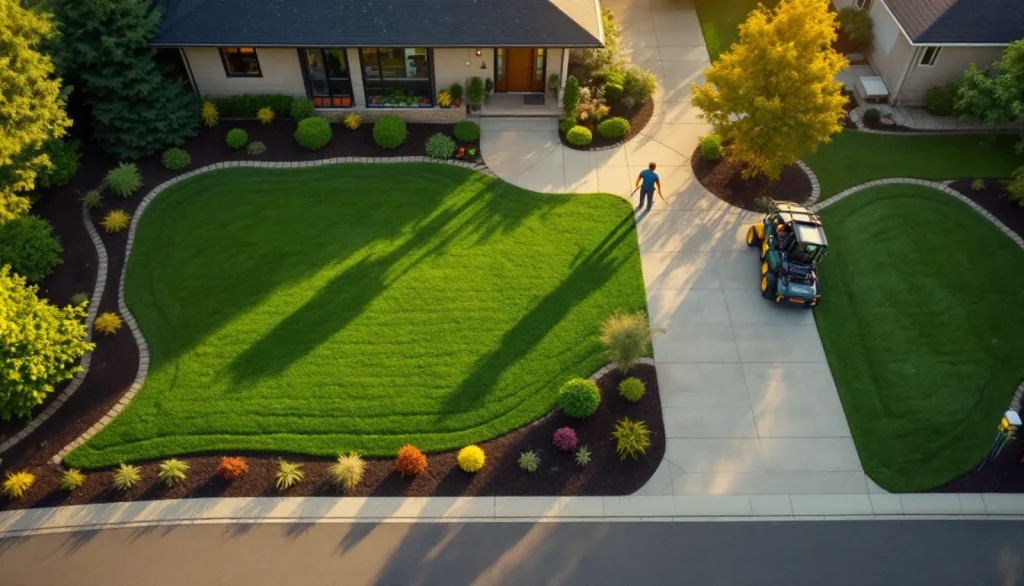
The lawn care cost in 2026 ranges from $35 per visit for basic mowing to $1,800 a year for a full-service program with fertilization, weed control, and aeration on a typical 5,000 sq ft suburban lawn. Most homeowners land between $1,200 and $2,200 a year for a six-treatment program plus weekly mowing in season. Regional swings move the price 30 to 50 percent in either direction.
The short version
- Mowing: $35-75 per visit on a 5,000 sq ft lawn, weekly in growing season
- Fertilization: $400-700 per year for a 6-treatment NPK program
- Weed control (pre and post-emergent): $300-600 per year
- Aeration + overseeding: $100-300 per fall application
- Pest control (grub, surface insect): $200-450 per year
- Full-service annual: $1,200-2,200, with $1,500-1,800 the typical median
What the numbers look like at the line-item level
The price of professional lawn care breaks into five line items, each with its own seasonal pacing and pricing logic. Mowing is the volume driver. Fertilization is the margin driver. The rest scales with property size and pest pressure.
| Service | Frequency | Cost per visit | Annual cost |
|---|---|---|---|
| Mowing (5,000 sq ft) | 26-32 visits | $35-75 | $910-2,400 |
| Fertilization (6-step NPK) | 6 visits | $65-120 | $390-720 |
| Pre-emergent weed control | 2 visits | $60-110 | $120-220 |
| Post-emergent broadleaf | 2-3 visits | $55-95 | $110-285 |
| Core aeration | 1 visit (fall) | $100-300 | $100-300 |
| Overseeding | 1 visit (fall) | $80-220 | $80-220 |
| Grub control | 1 visit (mid-summer) | $120-220 | $120-220 |
How regional pricing moves the number
The five forces that move lawn care pricing 30-50% in either direction from the national median: labor cost (Northeast and West Coast run highest, Sun Belt runs lowest), property density (city versus suburban versus rural), competition (5-company markets stay tight, 50-company markets get cut-throat), service mix (chemical-application-heavy programs price higher than mow-only), and climate season length (Texas and Florida run year-round, Minnesota runs 6 months).
Sun Belt cities (Phoenix, Tucson, Austin, Houston, Tampa) generally run 15-30% below the national median for mowing because of higher route density and longer season. Northeast and West Coast (Boston, NYC metro, San Francisco, Seattle) run 30-50% above because of labor cost. Mountain West (Denver, Salt Lake) runs near the median.
Bundle pricing versus a la carte
The full-service annual program (mowing + fertilization + weed control + aeration + grub) typically runs 10-15% less than purchasing each service separately because the operator amortizes the visit cost across multiple line items. A typical 6-step fertilization program with mowing bundled runs $1,500-1,800 annually for a 5,000 sq ft suburban lawn. Buying the same services individually from different operators usually pushes you to $1,800-2,100.
Where it does not pencil: if you mow yourself and only want chemical treatments, buying a 6-step program from a chemical-application-only operator like TruGreen or Spring-Green often costs less than bundling with a mow-and-chem hybrid. The math depends on what the operator can do in a 15-minute property visit.
Real brand pricing
Three national brands publish or quote consistent pricing across most markets. TruGreen runs $450-700 per year for the 8-step program on a 5,000 sq ft lawn (this is their highest-volume offering). Lawn Doctor typically runs 10-15% higher than TruGreen at $500-800 annually for comparable coverage but includes more localized agronomic adjustment. Spring-Green sits between the two at $475-725.
Independent local operators usually price 10-20% above the national chains for chemical-application programs and either 0-15% above for mowing depending on route density. The differential pays for more personalized agronomic decisions (the local operator notices the brown patch in week 3 instead of waiting for the scheduled visit).
DIY versus pro: when the math works each way
The DIY math: fertilizer bags from contractor-tier suppliers like Yard Mastery or SiteOne run $35-65 per 5,000 sq ft application (compared to $65-120 from the pro). Pre-emergent prodiamine concentrate runs about $25 per application self-applied. Post-emergent 3-way broadleaf herbicide runs about $15 per application self-applied. Add a $400 spreader and a $300 sprayer once.
The pure-chemical DIY math on a 5,000 sq ft lawn typically comes in at $250-400 a year in materials, versus $700-1,000 for the pro program. The pro covers the time, the agronomic decisions, the application timing, and the dump fee on the chemical container disposal. For homeowners who enjoy the project, DIY wins on cost. For homeowners who do not, the pro premium is the time premium.
For a deeper math walkthrough including spreader settings, see our lawn fertilizer calculator guide.
Hidden costs you will not see in the lead estimate
Five things that show up after the first season and were not in the initial estimate. Storm cleanup fees after wind events run $75-300 per crew hour and are usually billable separately. Pet damage repair (urine spots) runs $4-7 per spot for the gypsum or lime application, billed quarterly if pet damage is widespread. Tree root fertilization injection if the lawn shares root zone with stressed trees runs $150-350 per tree, usually fall application. Snow mold treatment in northern climates runs $100-180 per spring application. Soil testing for the next-season program runs $35-100 and is genuinely useful — without it, the operator is guessing at NPK ratios.
Find a contractor in your city
For vetted lawn care contractors in your city, see our Landscapers directory. For supplier pricing in your metro, see Suppliers. For a guide on selecting the right fertilization program, see our NPK fertilizer guide.
Bottom line
Plan on $1,500-1,800 a year for full-service lawn care on a typical 5,000 sq ft suburban lawn in 2026. Less if you DIY chemical application. More if you live in the Northeast, on a half-acre, or want a chemical-free organic program. Get three written estimates with line-item breakdowns before you sign anything, and ask each operator what is bundled, what is billed extra, and what their cancellation policy looks like.