
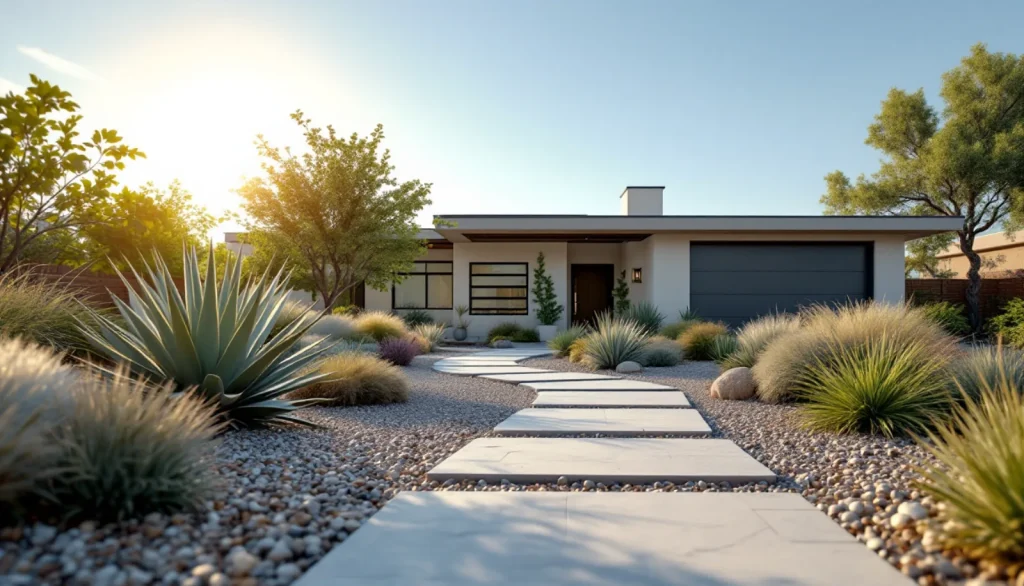
Drought-tolerant lawn alternatives include native plant ground cover, buffalo grass, no-mow fescue, clover lawns, and full xeriscape conversion. Costs in 2026 run $3-15 per square foot installed, depending on what you choose. Six Western states pay homeowners $2-6 per square foot in turf removal rebates that can cover 30-50% of the conversion cost. Here is what works, what does not, and how to capture the rebate money.
The short version
- Buffalo grass: native, drought-tolerant cool-season alternative, $0.75-1.50/sq ft seeded
- No-mow fescue: low-maintenance cool-season blend, $0.50-1.20/sq ft seeded
- Native ground covers: kinnikinnick, ice plant, sedum varieties, $3-8/sq ft installed
- Full xeriscape: gravel, agave, native shrubs, $8-15/sq ft installed
- State rebates 2026: NV $6/sq ft, CA $2-4, AZ $0.50-3, CO $1-3, UT $1.50, NM $1.50-2.50
- Most rebate programs cap at 5,000-10,000 sq ft per household
State rebate programs in 2026
Six Western states pay homeowners to remove turf grass. The programs vary in eligibility, payout, and cap. All require pre-approval before you start work and verification photos before paying out.
| State / Region | Rebate per sq ft | Maximum per household | Eligibility notes |
|---|---|---|---|
| Nevada (Southern Nevada Water Authority) | $6.00 | 10,000 sq ft | Most generous program; cool-season grass removal only |
| California (varies by water district) | $2-4 | 5,000-10,000 sq ft | SoCal MWD, San Diego, Bay Area programs all active |
| Arizona (Tucson Water, others) | $0.50-3 | varies | Tucson Water program strongest; Phoenix area smaller |
| Colorado (Denver Water, Aurora) | $1-3 | 3,000-10,000 sq ft | Front Range programs strongest |
| Utah (Weber Basin, Jordan Valley) | $1.50 | 5,000 sq ft | Park strip removal often higher rate |
| New Mexico (Albuquerque, Santa Fe) | $1.50-2.50 | varies | Albuquerque Bernalillo County Water Authority leads |
Rebate programs require: pre-application before work starts, before-photos of existing turf, post-install photos of approved replacement, approved plant list (most programs require minimum native plant percentages), and irrigation modification (replacing spray heads with drip or low-flow). For more on state water restriction tracking, see our regulatory desk.
Buffalo grass
Native to the Great Plains, drought-tolerant, cold-tolerant, and the lowest-maintenance turf alternative for most Western and Midwest yards. Hits 4-6 inches tall at full growth so it can be mowed monthly or not mowed at all. Color is blue-green (versus the bright green of Kentucky bluegrass).
Cost: $0.75-1.50 per sq ft seeded (about half the cost of seeding tall fescue). Sod runs $1.50-2.80 per sq ft if available; most buffalo grass installs are seeded. Best establishment window is late spring through early summer.
Water use: 1/3 to 1/2 the water of cool-season turf once established. Most established buffalo grass lawns need irrigation 1-2 times per month in summer, not weekly.
Limitations: Does not tolerate shade. Does not stand up to heavy foot traffic. Slow to establish (12-18 months to full coverage from seed). Goes dormant brown in extended cold snaps (which is the normal state, not damage).
No-mow fescue blends
Tall fescue, hard fescue, and chewings fescue mixes that grow to 6-8 inches and then stop. Mowed 0-3 times per year if you want to mow. Stays green longer than buffalo grass in cool climates. Sold under brands like Pearl’s Premium, Eco-Lawn, and No Mow Fescue Blend.
Cost: $0.50-1.20 per sq ft seeded. Available at most pro-tier seed suppliers.
Water use: 1/2 to 2/3 the water of standard tall fescue. Tolerates partial shade better than buffalo grass.
Limitations: Does not grow well below USDA zone 6 (too cold) or above zone 8 (too hot). Most appropriate for the Northeast, Midwest, Pacific Northwest, and mountain West.
Native ground cover
Permanent plantings of drought-tolerant native species that replace the lawn entirely. Common choices by region:
Southwest: Damianita (Chrysactinia mexicana), woolly stemodia (Stemodia lanata), Texas frogfruit (Phyla nodiflora). Spreading native ground covers that handle full sun and high heat.
California: Carmel creeper (Ceanothus griseus horizontalis), bearberry (Arctostaphylos uva-ursi), creeping wild ginger (Asarum caudatum). Native to California coast and inland coastal range.
Mountain West: Kinnikinnick (Arctostaphylos uva-ursi), creeping Oregon grape (Mahonia repens), pussytoes (Antennaria parvifolia).
Cost: $3-8 per sq ft installed with plants, drip irrigation, and 2-3 inches of mulch. Establishment takes 2-3 years to full coverage.
Water use: Once established (after year 2), most native ground covers need only natural rainfall plus occasional supplemental irrigation in extended drought.
Clover lawns
Microclover (Trifolium repens var.) or Dutch white clover replaces grass entirely or is mixed with grass at 5-10% by weight. Drought-tolerant, soil-fixing (adds nitrogen to the soil so you do not need synthetic fertilizer), pollinator-friendly.
Cost: $0.30-0.80 per sq ft seeded. Establishment is fast (4-8 weeks to full coverage from seed).
Water use: Similar to tall fescue. Clover is drought-tolerant but not as drought-resistant as buffalo grass or no-mow fescue.
Limitations: Honeybees and bumblebees visit clover flowers; some homeowners do not want bees in walking-foot zones. Does not stand up to dog urine well (clover is sensitive to nitrogen overload). Flowers attract some unwanted pollinators if the lawn is left unmowed.
Full xeriscape conversion
Replace turf with decorative gravel, boulders, agave, ocotillo, native flowering shrubs, ornamental grasses, and minimal drip irrigation. The full conversion approach: zero lawn, native plant focal points, gravel mulch over weed barrier.
Cost: $8-15 per sq ft installed. Higher end ($12-15) covers full hardscape integration, weed barrier, decorative boulders, larger nursery-stock plants.
Water use: 70-90% reduction versus turf grass once established. Most xeriscape gardens irrigate only the plant zones via drip, with the gravel mulch areas getting no irrigation.
Maintenance: Annual weeding, occasional pruning of overgrown plants, plant replacement every 5-10 years for short-lived species. No mowing, no fertilization, no pesticide.
Installation: pro vs DIY
DIY install works for buffalo grass and no-mow fescue (just seed the existing area after killing the old grass with glyphosate or solarization). Cost is materials only; total project cost runs $500-1,500 for a 1,000 sq ft conversion.
Pro install usually makes sense for native ground cover, xeriscape, and any conversion involving drip irrigation tied to an existing controller. Pro install on a 1,000 sq ft xeriscape runs $8,000-15,000 with all-new drip, weed barrier, gravel, plants. Rebate offsets 30-50% of this in the eligible states.
See our landscapers directory for vetted xeriscape contractors in your metro.
Bottom line
If you live in Nevada or coastal California, the rebate math makes turf removal a clear win on cash flow alone. In Arizona, Colorado, Utah, and New Mexico, the rebate makes it competitive but not free. Outside those states, the conversion math depends on long-term water bill savings and time-of-mowing reductions. Buffalo grass and no-mow fescue are the easiest entry points. Full xeriscape requires more planning but delivers the largest long-term water savings. For ongoing pricing on conventional lawn care, see our cost guide.