
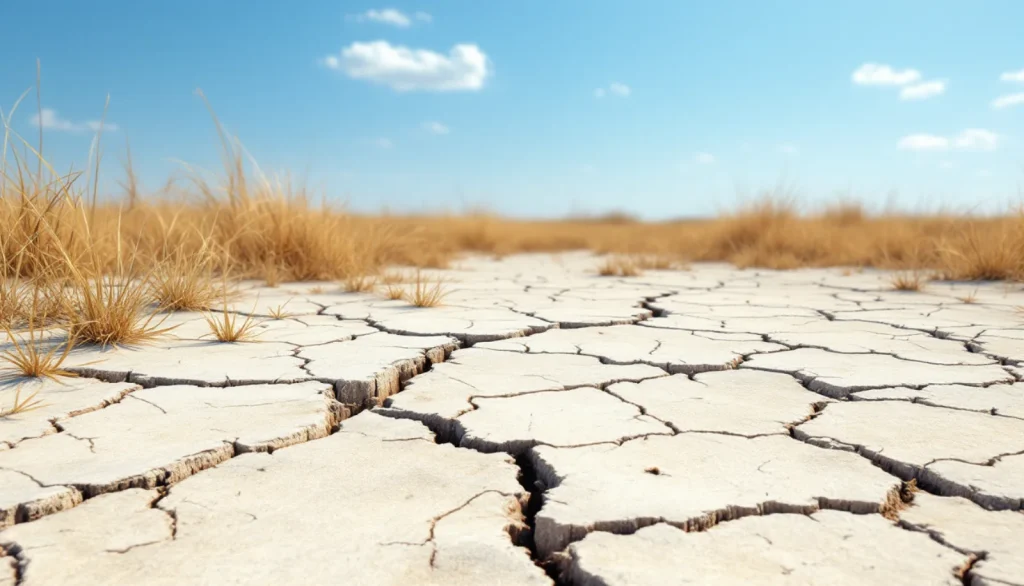
If you have ever wondered what causes drought in plain terms, the answer is the interaction of four variables: precipitation deficit, evapotranspiration spike, soil moisture depletion, and reservoir or groundwater drawdown. Drought is not one thing. It is a cascade. And the reason it matters for your lawn and landscape bill is that every stage of that cascade triggers a different utility response, and those responses are what move your water rates from $40 a month to $400 a month over the span of a single summer. Here is the trade-journalist version of how it works and what it costs you.
The short version
- Drought has four overlapping types: meteorological (rainfall deficit), agricultural (soil moisture), hydrological (reservoir and aquifer), and socioeconomic (mandatory restrictions). Your bill spikes at stage three.
- Western US is in a 24-year megadrought (2000 to 2024), driest period in 1,200 years per UCLA tree-ring research.
- Utility tiered rates triple or quadruple per gallon above the residential baseline. Tier 4 water in Las Vegas runs roughly 5x the tier 1 rate.
- Mandatory restrictions hit at Stage 2 (1 to 2 watering days per week) or Stage 3 (turf watering banned). Most Western utilities trigger Stage 2 below 65 percent reservoir capacity.
- Rebates fund conversion at the back end: Nevada $6/sq ft (cap 10,000), California $2 to $4, Arizona $0.50 to $3, Colorado $1 to $3, Utah $1.50, New Mexico $1.50 to $2.50.
- EPA WaterSense smart controllers cut outdoor use 30 to 50 percent regardless of drought stage, and pay back in 1 to 2 seasons at current Western water rates.
The four types of drought and why they matter for your bill
Meteorologists, hydrologists, and water utilities define drought four different ways. Knowing which type your region is in tells you exactly what is about to happen to your water rate, your watering schedule, and your lawn.
Meteorological drought is the simplest: precipitation is below the long-term average for an extended period, typically three months or more. The Palmer Drought Severity Index and the US Drought Monitor categories (D0 abnormally dry through D4 exceptional drought) measure this. At this stage your bill is normal but the utility is watching.
Agricultural drought follows when soil moisture in the root zone drops below what plants need. This can happen even without a meteorological drought if temperatures spike (more on evapotranspiration below). Lawns brown, agricultural yields drop, irrigation demand jumps, and homeowner water bills start climbing because you are running zones longer and more often.
Hydrological drought is when reservoirs, rivers, and aquifers drop. Lake Mead at 1,040 feet, Lake Powell below 3,525 feet, the Colorado River system below 35 percent capacity. This is the stage at which utilities trigger mandatory restrictions because supply is at risk. Tiered rate spikes kick in. The bill triples.
Socioeconomic drought is the policy response: mandatory restrictions, surcharges, conservation requirements, and (in worst cases) outdoor watering bans. By the time you see “Stage 3” headlines, you are paying tier-4 rates on whatever water you do use.
Cost of water at each drought stage
| Drought stage | Typical restriction | Effective rate vs baseline | Monthly bill (typical 5,000 sq ft lawn) |
|---|---|---|---|
| None (normal) | No restrictions | 1.0x | $60 to $120 |
| Stage 1 (voluntary) | Voluntary cutbacks, no penalty | 1.0x | $70 to $140 |
| Stage 2 (mandatory) | 2 days per week watering, time windows | 1.5 to 2.5x on overage | $140 to $350 |
| Stage 3 (severe) | 1 day per week or turf-watering ban | 3.0 to 5.0x on tier 4 | $300 to $700 |
| Stage 4 (emergency) | Outdoor water ban | Penalties up to $1,000 per incident | $80 to $200 plus fines |
The numbers above assume a standard Southern Nevada Water Authority or Metropolitan Water District tiered rate structure. Your local utility may differ, but the pattern (steep tier jumps at Stage 2 and above) is consistent across the West. For current contractor pricing on the services that adjust around these restrictions, see our lawn care cost guide.
Why the West is in a 24-year megadrought
The Western United States from 2000 through 2024 has been the driest 24-year period in roughly 1,200 years, according to tree-ring reconstructions published by UCLA and the US Geological Survey. The technical name is “megadrought” and it is driven by a combination of natural Pacific decadal oscillation (cooler Pacific surface temperatures that reduce Western precipitation) and anthropogenic warming (which increases evapotranspiration even when precipitation is normal). The practical result is that even a wet winter (like 2022 to 2023 in California) refills snowpack but not aquifers, which are 50 to 100 year recovery cycles when overdrawn.
This matters for your lawn bill because the policy assumption has shifted. Until roughly 2015, Western utilities planned for drought as a temporary anomaly. Since 2020, planning treats drought as the new baseline, which is why long-term tiered rate structures and permanent restrictions (year-round watering schedules, even in wet years) are spreading from Nevada and Arizona into California, Colorado, Utah, and New Mexico.
Evapotranspiration: the part nobody explains
Evapotranspiration (ET) is the combined rate at which water evaporates from soil and transpires through plant leaves. It is measured in inches per day. A typical Phoenix summer day has an ET rate of 0.3 to 0.4 inches, meaning your lawn loses that much water to the atmosphere whether you watered or not. A typical Denver summer day is 0.2 to 0.3 inches. A typical Sacramento summer day is 0.25 to 0.35 inches.
When temperatures spike above the long-term average, ET spikes too. A 5-degree summer temperature anomaly increases ET by 8 to 12 percent. Plants need more water just to stand still. This is the part of climate-driven drought that is invisible to homeowners: you can have normal rainfall and still be in agricultural drought because heat is pulling water out of the soil faster than the plants can use it. EPA WaterSense smart controllers (Rachio 3, Hunter Hydrawise, Rain Bird ESP-TM2 with LNK module) read local ET data and adjust irrigation in real time. That is the mechanism by which they cut outdoor use 30 to 50 percent: they water based on what the plants actually need today, not what your old timer assumed they needed in April.
How utility rate structures actually work
Most Western utilities use a four-tier residential rate structure. Tier 1 (the cheapest) covers indoor essential use, typically the first 6,000 to 10,000 gallons per month. Tier 2 covers efficient outdoor use, typically the next 10,000 to 20,000 gallons. Tier 3 covers excessive outdoor use, typically the next 20,000 to 40,000 gallons. Tier 4 is everything above that, priced at 4 to 6 times the tier 1 rate.
A 5,000 sq ft lawn watered to industry standard (1 inch per week, June through September) consumes roughly 13,000 gallons per month. That puts you mid-tier 2 in most utilities, $80 to $150 in irrigation cost per month. A 5,000 sq ft lawn watered the way most homeowners actually water (over-cycling, daily watering, afternoon watering with 30 to 40 percent evaporation loss) consumes 25,000 to 35,000 gallons per month, pushing you into tier 3 or tier 4 territory and $250 to $500 in irrigation cost. The first response to drought is not Stage 2 restrictions, it is your own tiered rate punishing inefficient watering. Cutting your usage 40 percent through smart controllers and proper scheduling often cuts your bill 60 percent because the savings come off the most expensive tier.
The rebate math by state
Utility rebates exist because every gallon a homeowner permanently removes from outdoor demand is cheaper for the utility than building new supply. Nevada’s $6/sq ft (cap 10,000 sq ft) at Southern Nevada Water Authority is the most aggressive in the country because Las Vegas pulls 90 percent of its water from Lake Mead, which has spent the last decade testing record lows. A 2,000 sq ft front-yard conversion pays out $12,000.
California rebates run $2 to $4 per sq ft depending on water district, with Metropolitan Water District of Southern California at $2 baseline and San Diego County Water Authority, Santa Clara Valley Water, and East Bay MUD stacking additional district money up to $4. Arizona is fragmented: Tucson Water pays up to $3, Phoenix-area utilities (City of Phoenix, Mesa, Scottsdale, Tempe) pay $0.50 to $1 per sq ft. Colorado Front Range utilities (Denver Water, Aurora Water, Colorado Springs Utilities) pay $1 to $3 per sq ft. Utah’s Weber Basin Water Conservancy District and Jordan Valley Water Conservancy District pay $1.50 per sq ft. New Mexico utilities (Albuquerque Bernalillo County Water Utility Authority, Santa Fe) pay $1.50 to $2.50 per sq ft.
For a deep dive on plant selection that meets rebate program requirements, see our guide on drought-tolerant lawn alternatives, and for prep sequencing on these conversions, see how to prepare for a drought.
Indoor versus outdoor water use
The EPA estimates the average American household uses 30 to 60 percent of its water outdoors, with the West skewing toward 60 percent and the Northeast skewing toward 30 percent. Outdoor use is where drought restrictions land and where rebates focus, but it is also where homeowners have the most room to cut. Replacing a toilet saves 0.5 to 1.5 gallons per flush. Converting 1,000 sq ft of turf to xeric in Phoenix saves roughly 30,000 gallons per year. The ratio is not close.
The other reason outdoor use gets the restriction treatment is that municipal water treatment costs the same whether the water ends up on grass or in a dishwasher. Outdoor irrigation is treated water sprayed onto plants that do not need treated water. Hence the persistent utility push toward graywater systems, rainwater harvesting (legal in all 50 states as of 2025 but with collection-volume caps in Colorado and Utah), and direct-to-drip irrigation that bypasses the spray-evaporation loss.
What climate models predict for 2026 to 2040
The federal Fifth National Climate Assessment (released 2023, current through 2030 planning cycles) predicts continued precipitation decline in the Southwest, especially in winter snowpack. Snowpack matters because it is the spring runoff that fills reservoirs. Earlier and faster snowmelt (which is what warmer winters produce) drains reservoirs faster and increases summer evapotranspiration demand simultaneously. The model output that water utilities are planning around: a 20 to 30 percent reduction in Colorado River flow by 2050, a 15 to 25 percent reduction in Sierra Nevada snowpack water content, and a 10 to 20 percent increase in summer ET demand across the West.
For your landscape, this means current restrictions are the floor, not the ceiling. The 2026 utility rate structure in Las Vegas, Phoenix, Denver, and Salt Lake City is more permissive than what 2035 will look like. Conversions and retrofits done now lock in lower bills against future rate hikes. Our research hub tracks model updates and regional projections as they release.
FAQ
Is climate change causing drought?
It is amplifying it. The natural Pacific decadal oscillation creates dry cycles in the West independent of climate change, but anthropogenic warming increases evapotranspiration and reduces snowpack regardless of precipitation, so the dry cycles hit harder and last longer. The current Western megadrought would have been roughly 40 percent less severe without the warming signal, per the UCLA study.
Why did my water bill triple this summer?
Almost always tiered rates plus over-watering, not the utility raising the base rate. Look at your bill: if you are in tier 3 or tier 4 by August, you are using 2 to 3 times more water than you need. A smart controller and a tuna-can test usually find the leak.
What is the difference between meteorological and hydrological drought?
Meteorological drought is a precipitation deficit (it stopped raining). Hydrological drought is a supply deficit (the reservoirs and aquifers are low). You can have one without the other. A dry summer in California after a wet winter is meteorological drought without hydrological drought. A dry summer after a dry winter is both.
Will the West run out of water?
Not in the catastrophic sense, but the cost and restrictions will keep climbing. The Colorado River compact allocations have already been renegotiated twice in the last decade. Phoenix-area new-construction water hookup approvals were suspended in 2023 in some Maricopa County tracts because groundwater modeling could not support 100-year supply requirements. The water is not gone, it is just allocated tighter.
Are drought rebates taxable?
Federal: no, after IRS Notice 2023-59 clarified that water-conservation rebates are excluded from gross income. State: varies, but California, Nevada, and Arizona all follow the federal exclusion. Talk to a CPA if your conversion rebate is above $10,000.
Bottom line
Drought is a cascade of precipitation deficit, evapotranspiration spike, supply drawdown, and policy response. Each stage hits your bill differently, and the West is in a 24-year megadrought that is not ending. The two cheapest defenses (smart controller plus proper scheduling) cut outdoor water use 30 to 50 percent and pay back in one or two seasons. The most expensive defense (lawn conversion) pays back faster than you think when stacked with state rebates.
The honest read on where Western water policy is heading: permanent year-round restrictions in most of Nevada and Arizona, tiered rate structures with steeper tier 3 and tier 4 jumps in California and Colorado, and continued rebate program expansion in Utah and New Mexico. If you live in any of these states, the question is not whether to convert. It is whether to convert now while rebates are stacked or later when they shrink. For sequence and timing, our drought prep playbook walks through the 12 steps in order.