
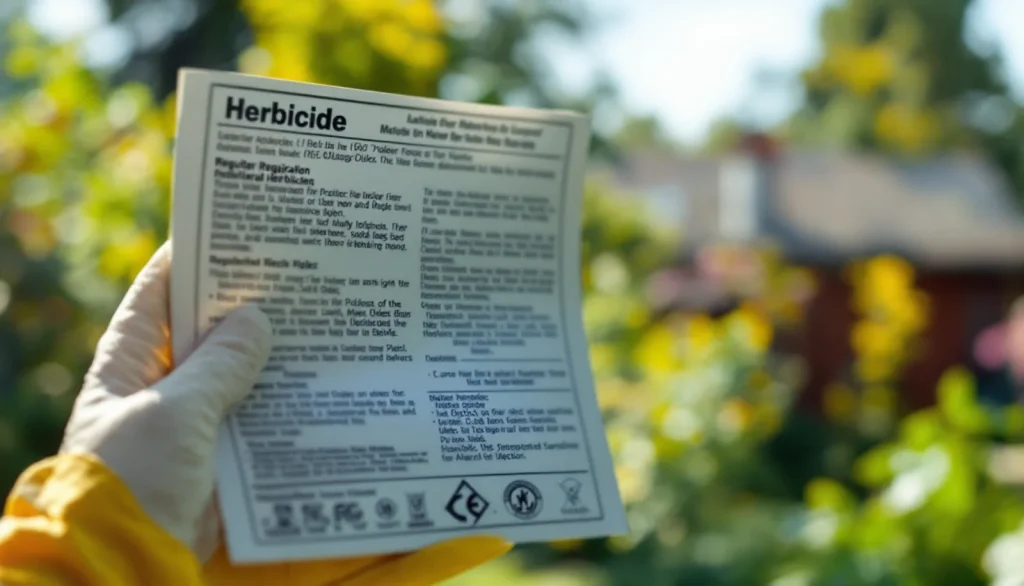
The herbicide definition question has three legitimate answers depending on who is asking and why. The scientific definition (used by the Weed Science Society of America and university extension programs) treats it as a phytotoxic chemical designed to kill or suppress plants. The regulatory definition (used by the EPA under FIFRA) treats it as a registered pesticide product whose label specifies plant-killing as the intended use. The practical definition (used by contractors and homeowners) treats it as whatever is in the jug they bought to deal with weeds. All three are correct, and they overlap, but they each emphasize something different. This guide walks through all three.
The short version
- Scientific definition (WSSA, 1956 and current): any substance used to kill or suppress the growth of plants.
- Regulatory definition (EPA under FIFRA): a registered pesticide product whose label identifies plant control as the intended use.
- Practical definition (industry): any product applied at label rate to kill unwanted vegetation in turf, beds, hardscape, or right-of-way.
- All three definitions agree on the substance: a chemical that kills plants.
- Major products that meet all three definitions: Roundup (glyphosate), Tenacity (mesotrione), T-Zone, Speedzone, prodiamine, atrazine, 2,4-D amine.
- Every herbicide sold in the US carries an EPA registration number, a federally approved label, and state-specific applicator license requirements for commercial use.
The scientific definition: WSSA and university extension
The Weed Science Society of America (WSSA), the professional society that defines terminology for the field, defines a herbicide as “a chemical substance used to kill or suppress the growth of plants.” This definition has been essentially stable since the society was founded in 1956. Every land-grant university extension service, every USDA technical bulletin, and every peer-reviewed weed science journal uses this definition.
Three things to notice about the scientific definition. First, it says “kill or suppress.” Suppression is a real category. Some herbicides do not kill the plant outright but slow its growth enough that desirable species can outcompete it. Plant growth regulators like trinexapac-ethyl (Primo Maxx) sit at the edge of this category. Second, it says “chemical substance.” That phrasing intentionally includes both synthetic and natural compounds. Pelargonic acid (a fatty acid derived from geraniums and sold as Scythe) is a herbicide. Acetic acid at 20 percent concentration is a herbicide. Iron HEDTA (sold as Fiesta) is a herbicide. Natural origin does not exempt a chemical from being a herbicide. Third, it says “plants.” Not “weeds.” A weed is a plant in the wrong place, which is a horticultural judgment, not a chemical category. The herbicide does not know whether the plant it is killing is a desirable or undesirable one. The applicator makes that choice.
The scientific definition matters because it determines what gets tested as a herbicide in a research setting. When North Carolina State or Penn State or University of California Cooperative Extension runs herbicide trials, they classify a test compound as a herbicide based on phytotoxicity (plant-killing activity), not based on marketing language or commercial registration. This is how research efficacy data ends up underpinning the labels you read at retail.
The regulatory definition: EPA and FIFRA
The Federal Insecticide, Fungicide, and Rodenticide Act of 1947 (FIFRA, amended substantially in 1972, 1996, and 2024) is the federal law that regulates pesticide registration and use in the United States. Under FIFRA, the term “pesticide” is defined in Section 2(u) as “any substance or mixture of substances intended for preventing, destroying, repelling, or mitigating any pest.” Plants that grow where they are not wanted are pests under this definition. A pesticide intended to control them is a herbicide.
The regulatory definition adds two things the scientific definition does not. The first is “intended use.” Under FIFRA, a chemical only becomes a regulated herbicide when it is sold or distributed with the intent of plant control. Glyphosate sitting in a chemistry lab is just a molecule. The same molecule in a Roundup jug with a label that says “kills weeds and grasses” is a federally regulated herbicide. The second addition is registration. Every herbicide sold in the United States must be registered with the EPA, meaning the manufacturer has submitted toxicology, environmental fate, and efficacy data, and the EPA has reviewed that data and issued a registration number.
| Regulatory element | What it means | Example |
|---|---|---|
| EPA Registration Number | Federal proof of registration under FIFRA Section 3 | EPA Reg. No. 524-475 (a Roundup product) |
| EPA Establishment Number | Identifies the facility where the product was made | EPA Est. No. 9779-MO-001 |
| Master label | Full FIFRA-approved use directions | Available via EPA Pesticide Product Label System (PPLS) |
| Signal word | Toxicity tier (Caution, Warning, Danger) | Most lawn herbicides: Caution |
| Use classification | General Use (GUP) or Restricted Use (RUP) | Glyphosate: GUP. Paraquat: RUP. |
| Re-entry interval | Time before treated area can be re-entered | Most lawn herbicides: until dry, 1 to 2 hours |
Restricted Use Pesticides (RUPs) can only be sold to and applied by certified applicators. Atrazine above 4 percent concentration is RUP. Paraquat is RUP. Several Group 4 synthetic auxins are RUP. General Use Pesticides (GUPs) can be bought by anyone, which is most of what sits on a Home Depot shelf.
FIFRA preempts state law in some areas (like labeling) and defers to states in others (like applicator certification). California, for example, has the California Department of Pesticide Regulation (CDPR), which adds California-specific registration on top of EPA registration. New York Local Law 37 effectively bans most synthetic herbicides on city-owned property and on public school grounds statewide. Maine’s BPC (Board of Pesticides Control) requires use reporting for all licensed applicators. Our regulatory tracker maintains state-by-state license categories, registration fees, and recent rule changes for 2025 and 2026.
The practical definition: what contractors and homeowners actually mean
When a homeowner walks into a hardware store and asks for “a herbicide,” they mean a product that will kill the unwanted plants in front of them. When a landscape contractor says they need to apply “herbicide” on a Tuesday morning, they mean a specific selection from a specific spray rig with a specific tank mix. The practical definition is operational: a herbicide is whatever product is matched to the job at hand.
The operational job almost always falls into one of three categories. Total kill (non-selective, like Roundup or Compare-N-Save). Selective broadleaf control in turf (like Speedzone or T-Zone or Trimec). Pre-emergent prevention (like Barricade or Dimension or Pendulum). A contractor reads the lawn, picks the category, picks the product within the category, and writes the work order. The chemistry does the rest.
The practical definition also includes some products that do not appear in the dictionary definition of “weed killer.” For example, plant growth regulators (PGRs) like Primo Maxx, used to slow grass growth on golf greens and high-end residential lawns, sometimes get bundled into “herbicide” conversations even though they technically suppress growth rather than kill. Crop desiccants used in agricultural settings (some glyphosate, some paraquat, some diquat) are functionally herbicides. Aquatic plant control products (fluridone, imazapyr) used in ponds are herbicides under a different label use site. The contractor’s mental category of “herbicide” is broader than the dictionary entry.
Where the three definitions disagree
Most of the time the three definitions overlap perfectly. Glyphosate is a herbicide under all three: it kills plants, it is registered with the EPA, contractors buy it to kill plants. Same for 2,4-D, mesotrione, prodiamine, atrazine, and every other major active ingredient.
Disagreement shows up in three edge cases. First, natural-origin contact compounds. Acetic acid (20 percent vinegar) is a herbicide scientifically (it kills plants), it is sometimes registered as a herbicide under FIFRA (OMRI-listed products like Green Gobbler, AllDown), but homeowners often do not think of it as a herbicide because it is sold as “weed killer vinegar.” The label tells you the regulatory truth.
Second, salt. Sodium chloride applied to soil kills plants, so it meets the scientific definition. But pure salt is not registered with the EPA as a herbicide, so it does not meet the regulatory definition. Using salt as a homemade weed killer is technically off-label pesticide use even though no FIFRA enforcement action would realistically follow for a homeowner. Don’t do it anyway. Salting soil ruins it for years.
Third, plant growth regulators. Trinexapac-ethyl (Primo Maxx), paclobutrazol (Trimmit), and ethephon (Proxy) do not kill plants. They alter growth. The EPA registers them as plant growth regulators, not herbicides. The scientific definition includes them because WSSA says “kill or suppress.” The contractor’s practical definition usually puts them in their own category. So a PGR meets the scientific definition, partly meets the regulatory definition, and gets handled as its own thing in practice.
Herbicide classification systems
Beyond the definition itself, the field has several formal classification systems that organize which compound goes in which bucket. Knowing the system matters for resistance management, because spraying the same mode of action year after year breeds resistant weeds.
HRAC / WSSA Mode of Action groups. The Herbicide Resistance Action Committee (international) and WSSA (United States) classify every herbicide by mode of action and assign it a group number. Glyphosate is Group 9. The synthetic auxins (2,4-D, dicamba, MCPP, triclopyr) are Group 4. Atrazine and simazine are Group 5. Mesotrione is Group 27. Prodiamine and pendimethalin are Group 3. The group number appears on most product labels in 2026. Resistance management means rotating across groups, not just rotating products within the same group.
Selectivity classification. Selective herbicides kill certain plants and leave others alone. Non-selective kill almost everything green. Most lawn post-emergents are selective broadleaf killers. Most burndown products are non-selective.
Timing classification. Pre-emergent herbicides are applied before weed seeds germinate. Post-emergent are applied after the weeds have already come up. Pre-emergents work as soil-residual barriers. Post-emergents work on foliage.
Movement classification. Systemic herbicides are absorbed and translocated through the plant’s vascular system, killing the whole plant including roots. Contact herbicides only burn the parts they physically touch. Glyphosate is systemic. Diquat is contact.
A complete herbicide description names all four: chemistry/group, selectivity, timing, movement. For example, glyphosate is Group 9 (EPSP synthase inhibitor), non-selective, post-emergent, systemic. Prodiamine is Group 3 (mitotic inhibitor), selective, pre-emergent, soil-residual. Tenacity (mesotrione) is Group 27 (HPPD inhibitor), selective, both pre and post-emergent, systemic. Accurate square footage measurement is the first input for applying any of these correctly because every label rate is given per 1,000 square feet of turf.
The label is the operational definition
FIFRA Section 12 makes it illegal to use a pesticide “in a manner inconsistent with its labeling.” This means the EPA-approved label is the operational definition of what the product is and how it can be used. Anything the label says is legally binding. Anything not on the label is not approved use.
This is why every honest discussion of a herbicide circles back to the label. The label says what active ingredient is in the jug. The label says what use sites are approved. The label says what rate to apply. The label says what personal protective equipment is required. The label says what re-entry interval applies after application. The label says what rotational crop restrictions apply (relevant in ag, less so in turf). The label says what tank mix partners are compatible. The label says what storage and disposal procedures apply.
If you have a question about a herbicide and the answer is not on the label, the manufacturer is required by FIFRA to maintain an EPA-approved technical bulletin or master label that supplements the consumer label. Bayer, BASF, Syngenta, Corteva, PBI-Gordon, and FMC all publish technical bulletins on their websites. The master label is also available on the EPA Pesticide Product Label System (PPLS). Reading the technical bulletin before tank-mixing or tricky applications saves a lot of off-target damage. For an overview of how weeds get diagnosed before any product gets selected, see our piece on brown patches in lawn.
Why precision in the definition matters
You might wonder why anyone bothers with the formal definitions when “kills plants” gets the job done. Three reasons.
First, legal compliance. State pesticide laws and OSHA hazard communication standards reference the regulatory definition. If you are a contractor and you misclassify a product (calling something a herbicide when it is not, or vice versa), you can mishandle storage, labeling, and reporting requirements and end up with a violation.
Second, resistance management. Herbicide resistance in the United States is real and growing. Palmer amaranth has evolved resistance to glyphosate, ALS inhibitors, and HPPD inhibitors. Annual bluegrass (Poa annua) has evolved resistance to multiple mode of action groups. Rotating chemistries within the same WSSA group is not real rotation. Knowing the group numbers and rotating across groups is real rotation.
Third, environmental and human safety. The toxicology and environmental fate of different chemistries vary by two or three orders of magnitude. Glyphosate has a soil half-life of about 7 to 60 days and very low aquatic toxicity. Atrazine has a soil half-life of 60 to 100 days and is a regulated groundwater contaminant under the Safe Drinking Water Act. Treating them as interchangeable members of the “herbicide” category misses the differences that actually matter for buffer distances to wells, water bodies, and sensitive plants.
FAQ
Is there a legal definition of herbicide in federal law?
Yes. Under FIFRA, a herbicide is a type of pesticide, and a pesticide is defined in Section 2(u) of the law as a substance intended to prevent, destroy, repel, or mitigate any pest. Plants growing where they are not wanted qualify as pests, and substances intended to control them qualify as herbicides.
Does the herbicide definition include organic products?
Yes. The definition is about function, not chemistry source. Pelargonic acid, acetic acid, iron HEDTA, and corn gluten meal are all herbicides when they are sold and used for plant control, regardless of their organic origin.
What’s the difference between herbicide and weedicide?
The two words are synonyms. “Weedicide” is used more in agricultural English (particularly Indian agricultural English) and “herbicide” is the standard term in North American and European English. Both refer to the same kind of plant-killing chemical.
Are plant growth regulators considered herbicides?
Scientifically, sometimes (WSSA’s definition includes suppression). Regulatorily, no (EPA registers them as PGRs, not herbicides). In practice, contractors handle them as their own category. A PGR like trinexapac-ethyl (Primo Maxx) slows grass growth without killing it, which is functionally different from any herbicide use.
Does the herbicide definition include soil sterilants?
Yes. Soil sterilants like imazapyr, hexazinone, and tebuthiuron are bare-ground herbicides that prevent vegetation regrowth for months or years. They are registered as herbicides under FIFRA, with use sites typically including industrial sites and right-of-way.
Bottom line
The herbicide definition has three valid forms. Scientifically, it is any chemical substance used to kill or suppress plant growth (WSSA, 1956 to present). Regulatorily, it is a pesticide product registered with the EPA under FIFRA whose label identifies plant control as intended use. Practically, it is whatever product a contractor or homeowner selects to kill unwanted vegetation, sorted into three working categories (total kill, selective in turf, pre-emergent prevention). All three definitions agree on the substance: a chemical that kills plants. For the everyday plain-English version, see our piece on herbicide meaning. For the full chemistry breakdown across major active ingredients, see what is a herbicide. For the cellular biochemistry of how each major active ingredient kills a plant, see how weed killer works.