
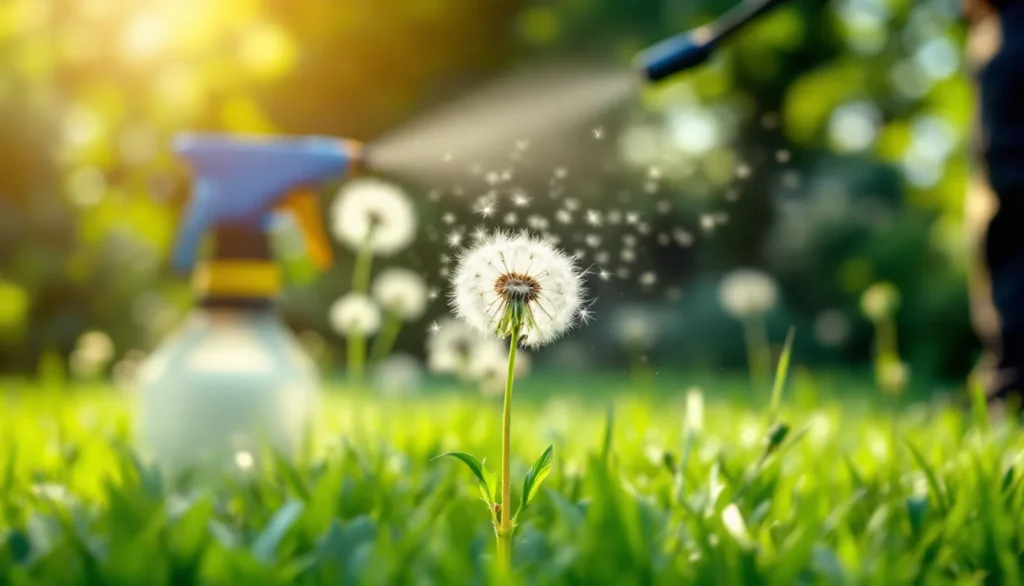
The herbicide meaning question gets asked more than you would think, and the answer is shorter than most search results make it sound. A herbicide is a chemical that kills plants. That is it. The word comes from Latin (herba meaning plant, cida meaning killer), the EPA defines it that way under FIFRA, and the Weed Science Society of America has used the same definition since 1956. The interesting part is not the definition itself, it is what the word actually covers and where the boundary lines sit between herbicide, pesticide, fungicide, and “weed killer.” This guide walks through the plain-English meaning and the categories underneath it.
The short version
- Herbicide means a plant-killing chemical. Same meaning as “weed killer” in everyday speech.
- Pronounced HER-buh-side. Latin roots: herba (plant) + cida (killer).
- A herbicide is one type of pesticide. The other big types are insecticide, fungicide, and rodenticide.
- Roundup, 2,4-D, Speedzone, Tenacity, Barricade, and T-Zone are all herbicides.
- Herbicides come in three big buckets: kills everything (Roundup), kills only certain weeds in a lawn (Speedzone), and prevents weeds from sprouting (Barricade).
- Every herbicide sold in the United States has an EPA registration number and a federally approved label that dictates legal use.
The plain-English definition
A herbicide is a chemical product designed to kill plants. The plants it is designed to kill are usually called “weeds” in everyday speech, which is just gardener shorthand for any plant growing where you do not want it growing. Crabgrass in a putting green is a weed. Bermudagrass in a tomato patch is a weed. The same exact species can be a desirable lawn or a hated weed depending on where it shows up.
So when someone says they need a herbicide, they mean they need to kill plants that have invaded a space where those plants are not wanted. They could mean killing dandelions in a lawn. They could mean killing poison ivy on a fence line. They could mean killing all green growth in a gravel driveway. All three are herbicide jobs, but they require very different products with very different chemistries.
The reason people use the technical word “herbicide” instead of just saying “weed killer” is that “weed killer” is too vague. There are thousands of herbicide products on the market in 2026, and most of them only kill specific kinds of plants. Asking for “weed killer” at SiteOne or Ewing without specifying the weed and the turf type will get you a follow-up question. Asking for “Tenacity” or “2,4-D amine” or “prodiamine 65 WDG” gets you the right jug.
Herbicide compared to other pesticide categories
| Term | Kills | Examples | Use in lawn care |
|---|---|---|---|
| Herbicide | Plants | Roundup, 2,4-D, Speedzone, Tenacity, Barricade | Weed control in turf and beds |
| Insecticide | Insects | Bifenthrin, imidacloprid, carbaryl, spinosad | Grub control, sod webworm, fire ant |
| Fungicide | Fungi | Azoxystrobin (Heritage), propiconazole, chlorothalonil | Brown patch, dollar spot, summer patch |
| Rodenticide | Rodents | Bromethalin, anticoagulants like brodifacoum | Vole and mouse control |
| Pesticide | Any of the above | Umbrella category, all of the above | The legal/regulatory term |
The thing to remember from that table is that every herbicide is a pesticide. The federal law that regulates them all (FIFRA, the Federal Insecticide, Fungicide, and Rodenticide Act) is the same law, the EPA registration system is the same system, and in most states the applicator license that covers commercial spraying is the same Category 3A Turf and Ornamental license whether you are spraying for weeds, bugs, or disease.
Three working categories most homeowners actually need to know
The technical literature lists about a dozen herbicide subcategories. In practical lawn-and-garden terms, you only need three.
Non-selective herbicides (the “kills everything” group). Roundup is the famous one. The active ingredient is glyphosate, which blocks an enzyme called EPSP synthase that essentially all green plants use to manufacture three essential amino acids. Spray it on a plant, the plant cannot make protein, and 7 to 14 days later it is brown and dead. Use cases: killing patches of lawn you want to replace, prepping a new bed, edging hardscape, knocking down weeds in a gravel driveway, killing brush along a fence line. Do not spray it across a lawn unless you want a dead lawn.
Selective broadleaf herbicides (the “kills weeds in your lawn” group). These products kill broadleaf weeds (dandelion, clover, plantain, chickweed) but leave grass alive. The classic active ingredients are 2,4-D, MCPP (mecoprop), dicamba, and triclopyr. The famous commercial blends are Speedzone, Trimec, and T-Zone, all made by PBI-Gordon. Use case: a lawn that is mostly grass with weeds growing in it, where you want the weeds dead and the grass intact.
Pre-emergent herbicides (the “prevents weeds before they sprout” group). These get applied to the soil surface before weed seeds germinate. The active ingredients (prodiamine sold as Barricade, pendimethalin, dithiopyr sold as Dimension) form a chemical layer in the top inch of soil that kills germinating seedlings as their root tips push through. Use case: crabgrass prevention in spring, winter annual prevention in fall. Timing window is narrow: apply when soil temps at 2 inches reach 50 degrees Fahrenheit. For more on calculating application rates by lawn size, see our guide to measuring lawn square footage.
Where “weed killer” and “herbicide” diverge in meaning
In everyday speech “weed killer” and “herbicide” are synonyms. In a hardware store either word will get you to the same shelf. But in regulatory documents and product labels they are not identical.
“Herbicide” is the legal and scientific term. It is the word the EPA uses, the word state pesticide programs use, the word university extension publications use, and the word every product label uses. If a product is being sold for the legal purpose of killing plants, the label has to identify it as a herbicide and carry the EPA registration number that proves it has been tested and registered.
“Weed killer” is the marketing term. It is what shows up on the front of the jug to communicate to a homeowner what the product does. Roundup branding now mostly says “weed and grass killer” rather than “herbicide” because consumers respond better to the plain English. Inside the carton the label still says herbicide, but the marketing copy uses what people search for.
This matters when you read articles or talk to contractors. If a contractor says they are applying “weed killer,” they usually mean a selective broadleaf post-emergent like Speedzone. If they say “herbicide,” they could mean any of the three categories above, and you should ask which one. If they say “pre-emergent,” they almost always mean a granular product like prodiamine spread in early spring. Vocabulary precision shortens conversations and prevents the wrong product from going down.
How a herbicide actually kills a plant (the 60-second version)
Every herbicide works by blocking one specific biochemical process the plant needs to live. Different chemistries block different processes. Here are the four most important ones in lawn care:
Glyphosate (Roundup) blocks the shikimate pathway. Plants use this pathway to make three amino acids (phenylalanine, tyrosine, tryptophan) that are essential for protein synthesis. No protein, no plant. The shikimate pathway does not exist in mammals, which is part of why glyphosate has historically been considered low toxicity to humans, though the 2015 IARC classification as “probable human carcinogen” and the Bayer settlement litigation have kept that debate active.
2,4-D and dicamba mimic the natural plant growth hormone auxin. When a plant is flooded with synthetic auxin, growth signals go haywire. Stems twist, leaves curl, cells divide uncontrollably in some places and not at all in others. The plant essentially grows itself to death over 7 to 21 days. Grasses metabolize these compounds quickly enough to escape damage, broadleaf weeds do not.
Mesotrione (Tenacity) blocks an enzyme called HPPD, which plants use in the synthesis of carotenoids. Carotenoids protect chlorophyll from photo-oxidation. Without carotenoids, sunlight bleaches the chlorophyll out of the leaves, you see the classic Tenacity “white tip” effect, and the plant dies of starvation 10 to 14 days later.
Prodiamine (Barricade) is a mitotic inhibitor. It binds to tubulin proteins in dividing cells and prevents the cell from completing mitosis. Germinating weed seedlings cannot establish a root system, and they die at the soil surface. Established plants with mature root systems are not significantly affected because their existing cells are not in active mitosis at the same rate.
For a deeper biochemical walkthrough of each major mode of action, see our companion piece on how weed killer works.
The label is the law: what every herbicide jug tells you
Federal law (FIFRA Section 12) makes it illegal to use a herbicide “in a manner inconsistent with its labeling.” That phrase covers everything: the rate, the use site, the timing, the rotation interval, the personal protective equipment requirements, the buffer distances to water bodies, and the re-entry interval. The label is not a suggestion. It is a federally enforceable document.
A herbicide label has six things you have to find before you spray:
Active ingredient and percentage. The chemistry, by weight. Roundup Pro Concentrate is 50.2 percent glyphosate. Tenacity is 40 percent mesotrione. T-Zone is a blend (triclopyr 8.24, sulfentrazone 0.61, 2,4-D 33.40, dicamba 2.36). Knowing the active ingredient tells you what the product can actually kill.
Use sites. The label specifies “residential turfgrass” or “non-crop industrial sites” or “right-of-way.” Spraying outside the listed sites is off-label and illegal.
Application rate. Always per 1,000 square feet for turf products or per acre for agricultural products. Always with a maximum annual rate.
Signal word. Caution, Warning, or Danger. Most homeowner-grade herbicides are Caution.
EPA Registration Number. The federal proof of registration. Looks like “EPA Reg. No. 524-549.”
Re-entry interval. How long until people and pets can walk on the treated area. For most lawn herbicides this is “until dry,” roughly 1 to 2 hours.
State regulators add their own layer. Most states require a Category 3A Turf and Ornamental commercial applicator license for anyone spraying herbicides for hire. New York Local Law 37 effectively bans most synthetic herbicides on city property. California requires Qualified Applicator Licenses and business licenses for commercial work. Our regulatory tracker covers state-by-state license requirements and recent rule changes in 2025 and 2026.
What herbicides are not
A herbicide is not a fertilizer. A fertilizer feeds plants you want. A herbicide kills plants you do not want. The two are entirely different chemistries with entirely different purposes, though they sometimes get sold combined as “weed and feed” products that include both a 2,4-D type herbicide and a granular fertilizer like 28-0-3. Weed and feed has its place but it is not always efficient because the optimal timing for fertilizer and the optimal timing for post-emergent herbicide are not always the same week. For more on dialing in nutrition independently of weed control, see our NPK fertilizer guide.
A herbicide is also not a soil amendment, not a soil sterilant in the legal sense (true sterilants are a different EPA category), not a fungicide (those kill fungi like brown patch and dollar spot), and not an insecticide (those kill insects like grubs and sod webworm). For diagnosing a turf problem before reaching for a product, see our guide to brown patches in lawn, which walks through the four most common causes that look like weed pressure but are not.
FAQ
Is “herbicide” the same as “weed killer”?
In everyday speech, yes. In product labeling and scientific use, herbicide is the technical term and weed killer is the marketing term. They refer to the same kind of product.
How do you pronounce herbicide?
HER-buh-side. The “h” is pronounced in American English. British English sometimes drops the h (“ER-buh-side”). Both are correct.
Is a herbicide a poison?
Technically yes, in the sense that it is designed to kill an organism (the plant). Whether it is toxic to humans depends on the specific active ingredient, the formulation, and the exposure level. Most homeowner-grade lawn herbicides carry the EPA “Caution” signal word, the lowest of three toxicity categories.
Can I make a homemade herbicide?
You can make a contact-only burndown with 20 percent horticultural vinegar (acetic acid), salt, and dish soap. It will burn the top growth of annual weeds. It will not kill perennial roots, it is not selective (it kills grass too), and applying salt repeatedly damages soil. OMRI-listed commercial options like pelargonic acid (Scythe) work better and do not salt the soil.
What is the most common herbicide?
Globally, glyphosate (Roundup) is the most-used herbicide by volume, with roughly 1.6 billion pounds applied worldwide annually as of the most recent USGS estimates. In residential lawn use, 2,4-D and combination products like Speedzone and Trimec are the most common selective post-emergents.
Bottom line
The herbicide meaning is simple: a chemical that kills plants. It is one type of pesticide, regulated by the EPA, sold in three working categories most homeowners need to know (non-selective like Roundup, selective broadleaf like Speedzone or T-Zone, pre-emergent like Barricade). Match the category to the job (kill everything, kill weeds in lawn, prevent weeds from sprouting), read the label rate, respect the timing window, and the product will do what the chemistry was designed to do. For the deeper definition that turf science programs and regulatory documents use, see our piece on what a herbicide is, and for the cellular-level biochemistry of how each major active ingredient kills a plant, see how weed killer works.