
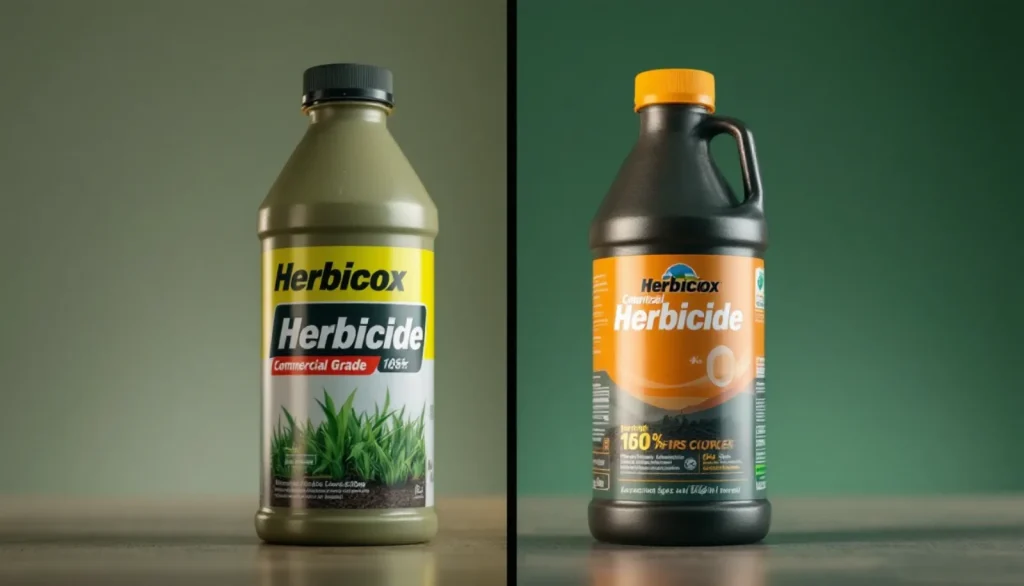
The phrase commercial grade weed killer gets used three different ways in 2026, and only one of them holds up at the supply counter. To a homeowner, it usually means “the strong stuff the pros use.” To a regulator, it means a product applied by a licensed commercial applicator. To a SiteOne or Ewing branch manager, it means an EPA-registered concentrate formulation with a label written for repeat use across multiple properties. The real difference between a $20 big-box bottle and a $115 jug of contractor-tier concentrate is not the molecule. It is the active ingredient concentration, the label specificity, and the cost per square foot of treated turf.
The short version
- Commercial grade is not a regulatory term. It refers to higher-concentration herbicide concentrates sold through wholesale supply at lower cost per square foot.
- Big-box Roundup is 2% glyphosate ready-to-use. Roundup Pro Concentrate is 50.2%. That is roughly 25x more active ingredient per volume.
- Cost per 1,000 sq ft of selective broadleaf application: big-box $4.50 to $9.00, commercial concentrate $0.50 to $1.20 in active ingredient cost.
- The four core commercial-grade products: Speedzone (broadleaf), Tenacity (crabgrass), Prodiamine 65 WDG (pre-emergent), Roundup Pro (non-selective).
- Most commercial-grade products are general-use and can be purchased by anyone, even without an applicator license, through SiteOne, Ewing, or online (DoMyOwn).
- The break-even point for switching from big-box to commercial-grade is roughly 3,000 sq ft of repeated use. Below that, big-box is cheaper for one-off jobs.
“Commercial grade” is a marketing term, not a regulatory category
EPA does not use the term “commercial grade” in any FIFRA registration document. The federal classification is general-use or restricted-use, applied to specific EPA-registered product labels. State applicator licensing uses “commercial applicator” to mean someone applying pesticides for hire, regardless of which product they are using. “Commercial grade weed killer” is what suppliers and contractors call the higher-concentration end of the product shelf, and what homeowners search for when they have decided the ready-to-use bottle is not getting the job done.
That said, the products in the category are real and identifiable. They share three traits. First, they come in concentrate form, typically 32 oz, 1 gallon, or 2.5 gallon containers. Second, the active ingredient concentration is much higher than the same brand’s ready-to-use version. Third, the label is written for site-by-site contractor application, with rates per 1,000 sq ft, multiple turf species tolerance tables, and weed-by-weed listings.
The mistake retail shoppers make is assuming the big-box Roundup, Ortho, and Spectracide products are the same chemistry as the pro versions. They share active ingredients but at concentrations 10 to 25 times lower, formulated for one-time use in a hose-end or trigger sprayer, with rates that cover a few hundred to a few thousand square feet.
Big-box vs commercial-grade: side by side
| Use case | Big-box product | Active % | Coverage | Cost per 1,000 sq ft | Commercial grade | Active % | Coverage | Cost per 1,000 sq ft |
|---|---|---|---|---|---|---|---|---|
| Non-selective | Roundup RTU | 2% glyphosate | ~400 sq ft per gal | ~$22.50 | Roundup Pro Concentrate | 50.2% glyphosate | ~25,000 sq ft per gal | ~$0.55 |
| Broadleaf selective | Ortho Weed B Gon RTU | 0.07% 2,4-D mix | ~600 sq ft per bottle | ~$5.00 | Speedzone Broadleaf | 3% carfentrazone + 2,4-D + MCPP + dicamba | ~24,000 sq ft per 32 oz | ~$4.80 |
| Crabgrass post | Scotts Crabgrass Killer RTU | 0.2% mix | ~500 sq ft per bottle | ~$6.00 | Tenacity | 40% mesotrione | ~12,800 sq ft per 8 oz | ~$0.75 to $1.00 |
| Pre-emergent | Scotts Halts | 1.71% pendimethalin granular | ~5,000 sq ft per 15 lb bag | ~$3.20 | Prodiamine 65 WDG | 65% prodiamine | ~200,000 sq ft per 5 lb | ~$0.45 |
| Crabgrass post (selective grass) | None at retail | n/a | n/a | n/a | Drive XLR8 | 18.92% quinclorac | ~85,000 sq ft per qt | ~$2.00 |
The non-selective comparison is the most dramatic. Roundup Ready-to-Use costs about 41 times more per square foot of treated area than Roundup Pro Concentrate. The selective broadleaf comparison is closer because Ortho Weed B Gon is fairly well-formulated, but Speedzone gives faster cool-weather kill and labels more weed species. The pre-emergent comparison is decisive: Prodiamine 65 WDG costs seven times less per square foot than Scotts Halts and lasts longer in the soil.
Where the cost difference actually comes from
The cost gap is not retail markup. It is formulation cost plus packaging cost plus distribution cost. Ready-to-use products carry water as 98% of their volume, which is heavy to ship and expensive to shelve. The plastic bottle and trigger sprayer add another $1.50 to $3 of cost per unit. The retail distribution channel takes a 30% to 50% margin, the manufacturer takes another 20% to 35%, and the brand pays for shelf space and advertising on top of that.
Concentrate formulations strip out the water and the trigger sprayer. A 32 oz Speedzone jug ships the same active ingredient as 240+ gallons of finished spray, but in a single container that weighs 2.5 lbs. Wholesale distribution through SiteOne and Ewing runs at 8% to 18% margin, with manufacturer margins typically 15% to 25%. The result is roughly an 8x to 20x cost reduction per ounce of active ingredient at the shelf.
The other side of the cost gap is volume discipline. Big-box products are designed for a 200 to 2,000 sq ft application. Most homeowners treat once, store the leftover bottle for two years, and throw it out at half full. Concentrate products are designed to be measured and mixed for a known turf area. The math only works if you actually use it.
The break-even point: when commercial grade pays off
For a one-time spot treatment of weeds in a 200 sq ft patio crack, big-box is cheaper. The $12 Roundup Ready-to-Use bottle treats the area and you walk away. Buying a $140 jug of Roundup Pro to spot-spray a patio is overbuy.
The break-even shifts when you have repeated applications on a meaningful turf area. Rough math:
- 5,000 sq ft lawn, 4 broadleaf applications per year: Big-box ready-to-use costs roughly $100 to $180 in product per season. Speedzone concentrate at $115 per 32 oz jug treats roughly 24,000 sq ft, or about 4 applications. Season cost is one jug, plus surfactant and a $40 backpack sprayer if you do not already own one.
- 10,000 sq ft lawn: Big-box cost roughly doubles ($200 to $350 per season). Commercial-grade cost is one jug of Speedzone plus one bottle of Tenacity, total $200 to $240 for the year, treating both broadleaf and crabgrass.
- 20,000+ sq ft or multi-property: Commercial grade is the only economically sensible option. Big-box product volume becomes a logistical problem (25+ trigger bottles to treat once).
The break-even point is roughly 3,000 sq ft of recurring treatment per year. Below that, the big-box product is cheaper after factoring in equipment and learning curve. Above that, commercial-grade concentrate is meaningfully cheaper per season, even before counting the better weed-species coverage. For sizing the lawn correctly before running this math, our how to measure lawn square footage guide walks through the four common methods.
What homeowners give up when buying commercial grade
Two things, and neither is the chemistry. First, packaging convenience. Concentrate products require a measuring jug, a backpack or pump sprayer, PPE (nitrile gloves, eye protection, long sleeves), and a place to store the concentrate. The MSRP-ready, trigger-spray, point-and-pull format of big-box products has real ergonomic value for one-time users.
Second, label simplicity. A big-box label says “apply to weeds, do not spray within 6 inches of desirable plants.” A commercial-grade label has 4 to 8 pages of dense text covering 50+ weed species, 8+ turf species with rate adjustments, REI by use site, environmental hazards, mixing instructions, storage, and disposal. The information is more useful, but only if you actually read it.
What homeowners gain is real. The cost per square foot drops by an order of magnitude. The product actually kills the weeds it claims to kill, with much better efficacy on tough species like wild violet, ground ivy, oxalis, and yellow nutsedge. The application is consistent because the measurement and dilution are explicit rather than implied by a hose-end dial setting. For homeowners willing to spend 90 minutes on the first calibration, the upgrade pays back in season one. The chemistry side is the same as what pros use, covered in our herbicide weed killer guide.
Where to buy commercial-grade products as a non-licensed buyer
Three channels work for non-licensed buyers. Online specialty retailers like DoMyOwn, Solutions Pest and Lawn, Forestry Suppliers, and Lawn Care Nut Shop carry the same wholesale SKUs at retail prices, typically 15% to 30% above wholesale but well below big-box per ounce of active ingredient. Shipping on heavy 2.5-gallon containers is the main cost, often $15 to $35 per order.
SiteOne Landscape Supply allows walk-in cash purchases at most branches for general-use products, no license check required. Account pricing is better than walk-in pricing, but you can establish a SiteOne Pro account as a small contractor or even as a homeowner doing meaningful volume, with business name and EIN.
Ewing Outdoor Supply has similar walk-in policy at most locations. Helena Agri-Enterprises and Nutrien Ag Solutions are agricultural-focused and less hospitable to small walk-in buyers but carry the deepest selection of industrial and ROW herbicides.
What does not work as a channel for commercial-grade products is Amazon for most categories. Amazon stocks ready-to-use big-box products at near-retail prices and a small selection of concentrates. Counterfeit and gray-market concentrate products show up regularly on Amazon listings, with labels that do not match the manufacturer’s current EPA registration. Stick to dedicated turf-supply channels.
Real application math for a 10,000 sq ft homeowner program
The four-product spring-to-fall program on a 10,000 sq ft cool-season lawn:
- Early spring pre-emergent: Prodiamine 65 WDG at 0.5 oz per 1,000 sq ft. 5 oz per application, 80 oz per 5 lb bag, 16 applications per bag. Bag cost $90. Cost per application: $5.60.
- Late spring broadleaf: Speedzone Broadleaf at 1.3 oz per 1,000 sq ft. 13 oz per application, 24 applications per 32 oz jug, plus surfactant. Jug cost $115. Cost per application: $4.80.
- Mid-summer crabgrass and nutsedge: Tenacity at 5 oz per acre, or 0.115 oz per 1,000 sq ft. 1.15 oz per application, 7 applications per 8 oz bottle. Bottle cost $95. Cost per application: $13.60.
- Fall broadleaf: Second Speedzone application from same jug. Cost per application: $4.80.
- Season total product cost: roughly $29 for the 10,000 sq ft lawn for the full year, plus $40 to $90 for a backpack sprayer and $15 to $25 for surfactant and dye.
Compare that to hiring a contractor at $350 to $750 per year for a 5-application program on the same lawn, or buying big-box ready-to-use products at roughly $200 to $400 per year in product alone. The DIY math with commercial-grade concentrate is the cheapest of the three by a wide margin if your time has a value below $50 per hour and you enjoy the work. The contractor math wins on time and convenience, and avoids the equipment and disposal hassle. The big-box math loses on both axes, which is why it persists mainly for one-off problems and renters. For the contractor side of the cost picture, see our lawn care cost guide and the learn pillar for the calendar.
The license question for homeowners using commercial-grade products
If you are applying general-use pesticides to your own property, no license is required under federal or any state law. Buying Speedzone or Tenacity for your own lawn is legal in all 50 states without certification. The label still applies. Following the rate, REI, PPE, and disposal instructions is your responsibility.
If you apply herbicides for hire on someone else’s property, even on a one-time basis, most states require a commercial applicator license (typically Category 3A Turf and Ornamental). The threshold varies by state. California’s QAL program kicks in for any paid application. Texas allows informal helpers under direct supervision of a licensed applicator. Florida requires a Limited Commercial Landscape Maintenance license for any applied pesticide.
Restricted Use Products (RUPs) require a license to purchase regardless of intended use site. Most commercial-grade lawn herbicides (Speedzone, Tenacity, T-Zone, Prodiamine, Drive XLR8, Roundup Pro) are general use and can be purchased without verification. The license matters most when moving to industrial or right-of-way chemistry, which is covered in our industrial weed killer guide and the broader regulatory hub.
FAQ
Is commercial grade weed killer stronger than what I can buy at Home Depot?
Yes, in terms of active ingredient concentration. The chemistry is the same but the percentage of active ingredient per ounce of product is typically 10 to 25 times higher. After dilution at label rate, the spray hitting the weed is similar in concentration, but you treat 20x more square footage per dollar.
Can I use commercial grade weed killer on my home lawn?
Yes. Federal law allows homeowners to apply any general-use pesticide on their own property without a license. Read the label, follow the rate and PPE, and use appropriate spray equipment.
What is the best all-around commercial grade weed killer?
For broadleaf weeds in a lawn, Speedzone Broadleaf Herbicide (carfentrazone + 2,4-D + MCPP + dicamba) is the contractor default. For crabgrass and selective grass weeds, Tenacity (mesotrione). For non-selective vegetation control, Roundup Pro Concentrate (50.2% glyphosate). For pre-emergent crabgrass prevention, Prodiamine 65 WDG.
How long does a commercial grade weed killer take to work?
Visible damage on broadleaf weeds: 24 to 72 hours with contact + systemic combos like Speedzone or T-Zone. Full kill: 7 to 14 days. Glyphosate: 5 to 10 days for annual weeds, 14 to 21 days for perennial weeds. Tenacity shows characteristic white bleaching within 5 to 7 days, full kill in 2 to 3 weeks.
Do I need PPE to apply commercial grade weed killer?
The label specifies the minimum PPE for that product. Almost all selective and non-selective concentrates require long sleeves, long pants, chemical-resistant gloves (nitrile or butyl), and protective eyewear during mixing and loading. Some products require an additional respirator or face shield. Follow the label.
Bottom line
Commercial grade weed killer is the same chemistry the big-box brands sell, packaged as concentrate, labeled for repeated use across multiple sites, and priced to make sense at scale. A homeowner with a 5,000+ sq ft lawn who is willing to mix and measure can cut annual product cost by 70% to 90% by switching from ready-to-use bottles to wholesale concentrates, with much better weed-species coverage and faster results.
The four-product home stack (Prodiamine 65 WDG, Speedzone, Tenacity, Roundup Pro Concentrate) costs about $400 to buy at SiteOne or DoMyOwn and treats a 10,000 sq ft lawn for two to three seasons. Add a $50 backpack sprayer, a few hours of calibration time, and the right PPE, and the DIY math beats the big-box math by an order of magnitude. The label is the operating manual. The math takes care of itself.