
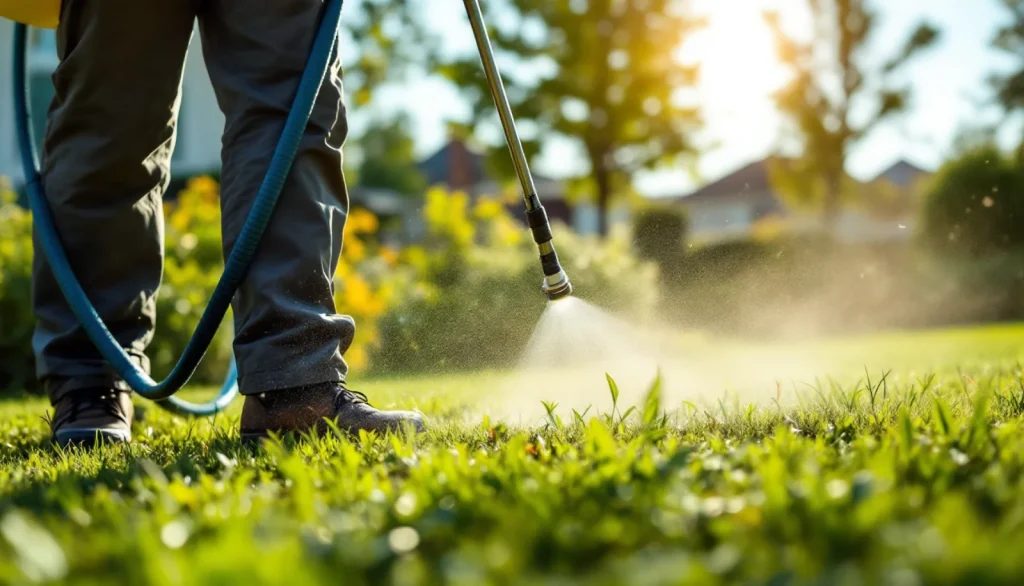
Picking the right herbicide weed killer in 2026 comes down to four decisions, in this order: selective or non-selective, pre-emergent or post-emergent, contact or systemic, and whether the active ingredient is legal to apply on your turf species in your state. Get those four right and a $40 jug of concentrate handles a season on a 10,000 sq ft lot. Get them wrong and you either kill your fescue along with the dandelions, or you spray $200 worth of product that washes off in the next rain.
The short version
- Selective herbicides (Speedzone, T-Zone, Tenacity) kill broadleaf weeds without harming turf. Non-selective (Roundup, glyphosate) kills everything green.
- Pre-emergent (prodiamine, dithiopyr) goes down before weed seeds germinate. Post-emergent treats weeds already growing.
- Active ingredients matter more than brand. 2,4-D, dicamba, triclopyr, MCPP are the broadleaf workhorses. Glyphosate is the total-vegetation knockdown.
- Contractor pricing for a 5,000 sq ft lawn herbicide application runs $50 to $90 per visit, or $0.01 to $0.018 per sq ft.
- EPA-registered products carry a 4-digit EPA Reg. No. on the label. Restricted-use products (RUPs) require a licensed applicator under Category 3A Turf and Ornamental in most states.
- Mesotrione (Tenacity) is the one selective that kills crabgrass post-emergent without killing cool-season grass. It is the most-asked-about pro product in 2026.
What “herbicide” actually means on the EPA label
A herbicide is any substance, biological or chemical, registered with the EPA under FIFRA (Federal Insecticide, Fungicide, and Rodenticide Act) to kill or suppress plant growth. Every legitimate herbicide weed killer sold in the United States carries an EPA Registration Number on the label, typically formatted as “EPA Reg. No. 538-318” or similar. If a product does not show that number, it is not a legal herbicide for use on residential or commercial property.
The label is not a marketing document. It is a legal document. The application rates, target species, turf tolerance, re-entry interval (REI), and personal protective equipment (PPE) requirements printed on the label are federally enforceable. Applying a product off-label, including at a higher rate or to a non-listed site, is a federal violation under FIFRA Section 12(a)(2)(G). State enforcement typically falls to the Department of Agriculture or equivalent regulator.
For contractors, that label compliance is the difference between a $90 application and a $5,000 fine. For homeowners, it usually means reading two pages of small print before pulling the trigger on a backpack sprayer. The good news is the label tells you everything: rate per 1,000 sq ft, mix ratio, turf species tolerance, and which weeds the product actually kills.
Selective vs non-selective: the first decision
Selective herbicides kill specific plant types and leave others alone. Non-selective herbicides kill anything green they touch. That single distinction drives 80% of product selection.
| Type | Active ingredient | Kills | Safe on (turf) | 2026 retail (32 oz concentrate) |
|---|---|---|---|---|
| Selective broadleaf | 2,4-D + MCPP + dicamba | Dandelion, clover, plantain, chickweed | Cool and warm-season turf (read label) | $22 to $35 |
| Selective broadleaf pro | Carfentrazone + 2,4-D + MCPP + dicamba (Speedzone) | Tough broadleaf, fast burndown | Most turf species | $95 to $130 |
| Selective grass+broadleaf | Mesotrione (Tenacity) | Crabgrass, nutsedge, broadleaf, bentgrass | KBG, fescue, ryegrass, centipede | $80 to $110 (8 oz) |
| Selective grass killer | Sethoxydim or fluazifop | Annual and perennial grasses | Broadleaf ornamentals, ground covers | $28 to $45 |
| Non-selective | Glyphosate 41% to 50.2% | Everything green (systemic) | Nothing (kills turf) | $30 to $60 |
| Non-selective burndown | Glufosinate, diquat, pelargonic acid | Everything green (contact) | Nothing (kills turf) | $45 to $130 |
For a contractor running a residential lawn care route, the selective broadleaf product (typically Speedzone or T-Zone) is the default spring and fall application. For a hardscape, fence line, or full renovation prep, non-selective glyphosate handles the kill. The mistake amateurs make is reaching for Roundup on a lawn because they recognize the brand. Roundup kills the weeds and the grass. Read the label.
Pre-emergent vs post-emergent: timing is everything
A pre-emergent herbicide sits in the top half inch of soil and prevents weed seeds from germinating. It does nothing to weeds already growing. A post-emergent kills weeds that are already up and leafing out, but does nothing to seeds still in the ground.
The big pre-emergent active ingredients in 2026 are prodiamine (the gold standard, sold as Barricade, Prodiamine 65 WDG), dithiopyr (Dimension, also gives a few weeks of post-emergent on small crabgrass), pendimethalin (Pendulum, the cheap option), and isoxaben (Gallery, for broadleaf control in beds). Timing is critical. The rule of thumb is to apply when soil temperature at 2 inches hits 50 to 55 degrees F for 3 to 5 consecutive days. In zone 6 that is typically late March to mid-April. In zone 8 it can be late February. Miss the window by two weeks and crabgrass is already up.
Post-emergent timing is about weed size. Most broadleaf herbicides work best when weeds are actively growing and less than 4 inches tall. Apply when daytime temps are between 60 and 85 degrees F. Below 50, the weeds are not metabolizing fast enough to translocate the chemical. Above 90, you get volatilization and turf injury. For granular weed-and-feed combo products, the same 60 to 85 window applies, plus the foliage needs to be damp so the granules stick.
Contact vs systemic: how the chemistry actually works
A contact herbicide kills only the plant tissue it touches. It does not move through the plant. Diquat, pelargonic acid (the active in many “organic” burndown products like Avenger and Scythe), and glufosinate are contact herbicides. They are fast (visible damage in 1 to 4 hours) but they only kill the leaves. Perennial weeds with deep roots, like dandelion or bindweed, regrow.
A systemic herbicide is absorbed by foliage or roots and translocated through the plant’s vascular system. Glyphosate is the textbook example. It takes 7 to 14 days to show full kill but it reaches the root crown and rhizomes. For perennial weeds, systemic is the only option that works. For annual weeds, contact is often faster and cheaper.
Hybrid products mix both. T-Zone SE (sulfentrazone + 2,4-D + MCPP + dicamba) gives a contact burn from the sulfentrazone plus systemic translocation from the auxin herbicides. That combo is why pros use it in cool weather, when systemic-only products move too slowly. For a deeper read on what is actually happening inside the plant, see how weed killer works.
The active ingredient cheat sheet for 2026
Brand names rotate. Active ingredients do not. Memorize this short list and you can decode any product label.
| Active ingredient | Class | Best for | Common brand |
|---|---|---|---|
| Glyphosate | Non-selective systemic | Total vegetation kill, renovation prep | Roundup Pro, Ranger Pro, Cornerstone Plus |
| 2,4-D | Selective broadleaf (auxin) | Dandelion, plantain, clover | Trimec, Weed B Gon |
| Dicamba | Selective broadleaf (auxin) | Hard-to-kill broadleaf, chickweed | Banvel, in most 3-way mixes |
| Triclopyr | Selective broadleaf (auxin) | Woody weeds, oxalis, wild violet | Turflon Ester, T-Zone |
| Mesotrione | Selective HPPD inhibitor | Crabgrass, nutsedge, broadleaf, new seedings | Tenacity |
| Prodiamine | Pre-emergent | Crabgrass, annual bluegrass | Barricade, Prodiamine 65 WDG |
| Dithiopyr | Pre + early post | Crabgrass (also kills small crabgrass) | Dimension |
| Sulfentrazone | Contact + residual | Sedge, kyllinga, broadleaf | Dismiss, in T-Zone |
| Quinclorac | Selective | Crabgrass (post), clover | Drive XLR8 |
| Imazapyr | Total vegetation, long residual | Industrial sites, fence lines | Arsenal, Polaris |
For homeowner use, the 3-way amine mix (2,4-D + MCPP + dicamba) is the workhorse. It is what most “weed and feed” granular products use. For contractor use, the ester formulations (T-Zone, Speedzone Southern) give faster kill in cool weather but have higher volatility risk in heat above 85.
Real pricing: what an application actually costs in 2026
Concentrate pricing is the only honest way to compare. Ready-to-use (RTU) bottles cost 5 to 10 times more per ounce of active ingredient. Here is the math on a typical contractor selective broadleaf application:
- Product: Speedzone Broadleaf Herbicide, 32 oz concentrate, $115 retail at SiteOne or Ewing.
- Rate: 1.1 to 1.5 oz per 1,000 sq ft (label rate for cool-season turf).
- Coverage: 32 oz / 1.3 oz avg = 24,615 sq ft per bottle, call it 24,000.
- Cost per 1,000 sq ft: $115 / 24 = $4.79.
- 5,000 sq ft lawn product cost: $23.95.
- Contractor pricing to homeowner: $50 to $90 per visit, depending on lawn size and route density. That is documented in our 2026 lawn care cost guide.
The gross margin on a selective herbicide application is the highest of any lawn care line item, typically 70% to 80%. Pre-emergent applications run similar math: Prodiamine 65 WDG at $80 to $95 for a 1 lb bag covers 200,000+ sq ft at 0.5 oz per 1,000, so product cost is under $0.50 per 1,000 sq ft.
For homeowners doing it themselves, the same concentrate costs the same. A $115 jug of Speedzone treats your 5,000 sq ft lawn 4 to 5 times. Compared to the $20 ready-to-use spray bottle that treats 200 sq ft, the concentrate is roughly 12 times cheaper per square foot.
Restricted-use products and applicator licensing
Most herbicides sold to homeowners and small contractors are “general use” products. A smaller category, designated Restricted Use Pesticide (RUP) on the label, can only be purchased and applied by a licensed applicator or someone working under direct supervision. RUPs include products containing paraquat, certain dicamba formulations approved for over-the-top soybean use, and many of the long-residual industrial herbicides used on rights-of-way.
For lawn and ornamental contractors, the relevant license in most states is the Commercial Applicator License, Category 3A Turf and Ornamental. The structure varies by state. Texas calls it the Structural Pest Control Service license through TDA. California runs it through the Department of Pesticide Regulation as a Qualified Applicator License (QAL), Category B. Florida licenses it through FDACS as a Limited Commercial Landscape Maintenance certification or full Commercial Applicator. Most states require a written exam, 4 to 8 hours of continuing education annually, and liability insurance.
Operating without a license while applying pesticides for hire is a violation in every state. Fines range from $250 for a first offense in some states to $5,000+ per violation in others. For the regulatory side of lawn services and a state-by-state summary, see our regulatory hub.
Common application mistakes and what they cost
Applying selective broadleaf herbicide above 90 degrees F is the single most common mistake. The auxin chemistry volatilizes, drifts onto ornamentals, and burns the turf. Damage shows up as twisted, cupped leaves on tomatoes, grapes, and Japanese maples for 100+ feet downwind. Most homeowner damage claims to a contractor’s insurer come from exactly this scenario.
The second mistake is misjudging spray volume. Most labels specify a finished spray volume of 0.5 to 2 gallons per 1,000 sq ft. Spray too light and coverage is patchy. Spray too heavy and the active ingredient runs off the leaf. Calibrate the sprayer by walking a measured 1,000 sq ft test strip with water only and weighing what you applied.
The third mistake is mowing too soon. Most post-emergent labels specify 24 to 48 hours before mowing. Mow earlier and you remove the leaf tissue that needs to absorb the chemical. Combine that with a poor watering routine and you waste the application entirely. For a primer on coordinating herbicide with the rest of your lawn program, our learn pillar walks through the seasonal calendar.
FAQ
What is the strongest herbicide weed killer available to homeowners?
For total kill of everything green, glyphosate at 41% to 50.2% concentration (Roundup Pro Concentrate, Ranger Pro, Cornerstone Plus) is the strongest non-restricted product. For selective broadleaf control in turf, Speedzone Broadleaf Herbicide and T-Zone SE are the strongest contractor-tier products available without a restricted-use license.
How long does herbicide stay active in soil?
Glyphosate binds tightly to soil and is inactivated within days. 2,4-D, MCPP, and dicamba break down in 7 to 30 days depending on soil temperature and microbial activity. Prodiamine and other pre-emergents are designed to last 3 to 6 months. Imazapyr and other long-residual industrial herbicides can persist 6 to 24 months, which is why they are reserved for non-crop sites.
Is Roundup still legal in 2026?
Yes. Glyphosate remains EPA-registered and legal in all 50 states for residential and commercial use, with some local jurisdictions (a handful of cities and counties) restricting it on public property. The Bayer-Monsanto litigation has not changed the federal registration. Read your county and HOA rules.
Can I mix two different herbicides together?
Sometimes, but only if both labels permit tank-mixing and you do a small jar test first to confirm physical compatibility. The most common pro mix is a selective broadleaf product plus mesotrione (Tenacity) for combined broadleaf and crabgrass control. Never mix glyphosate with a selective herbicide on a lawn you intend to keep.
Do I need a license to spray herbicide on my own property?
No. Federal law allows homeowners to apply general-use pesticides on their own property without a license. You still must follow the label rate, PPE, and re-entry interval. Restricted-use products (RUPs) require a license regardless of who owns the property.
Bottom line
Herbicide selection in 2026 is not about brand. It is about matching the active ingredient to the weed, the timing to the lifecycle, and the application rate to the label. A $115 jug of Speedzone, a $90 bag of prodiamine, and a $100 bottle of Tenacity cover almost every selective herbicide need a residential contractor or serious homeowner has for a full season on a 10,000 sq ft property.
If you only remember three things: pre-emergent goes down before the weeds come up, selective products read the turf label, and non-selective glyphosate kills your lawn just as fast as the weeds. Everything else is mix ratio, timing, and license category.