
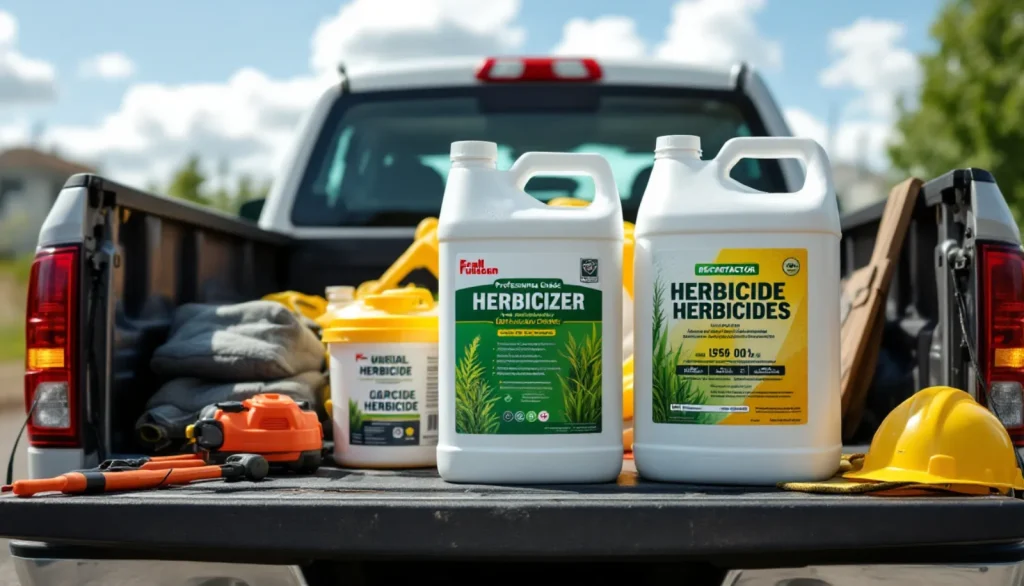
A professional weed killer is not a marketing label. It is a category of herbicide concentrate sold through wholesale turf supply (SiteOne, Ewing, Lesco, Howard Fertilizer) at higher active-ingredient percentages than big-box retail products, with EPA labels written for licensed commercial applicator use. The difference between a $20 Roundup spray bottle from Home Depot and a $115 jug of Speedzone from SiteOne is not a 5x markup on the same chemistry. It is 10 to 20 times more active ingredient per dollar, plus a label that lists weed species and turf tolerances big-box products do not.
The short version
- Pro herbicides come from SiteOne, Ewing, Lesco, Howard, and Helena Agri-Enterprises, not Home Depot. Concentrate format only.
- The four workhorses: Speedzone (broadleaf), T-Zone SE (cool-season broadleaf), Tenacity (crabgrass + broadleaf), Prodiamine 65 WDG (pre-emergent).
- Cost per 1,000 sq ft of a contractor-tier selective application is $4 to $7 in product, billed at $50 to $90 retail. Gross margin runs 70% to 80%.
- Most pro products are general-use. Some, like products containing paraquat or certain dicamba formulations, are Restricted Use (RUP) and require a Category 3A Turf and Ornamental license.
- SiteOne accounts require business license, EIN, and proof of applicator certification or supervision. Walk-up cash purchases are limited.
- Spray equipment matters as much as chemistry. A calibrated 4-gallon backpack sprayer with TeeJet flat-fan nozzles outperforms a $300 hose-end sprayer every time.
What separates a professional weed killer from a consumer product
Three things distinguish pro from retail. First, concentration. Big-box ready-to-use Roundup is 2% glyphosate. Roundup Pro Concentrate and Ranger Pro are 41% to 50.2%. That is 20 to 25 times more active ingredient per volume. Second, label specificity. Pro labels list 100+ weed species by name, with rates by species and turf type. Retail labels list 20 to 30 common weeds and one rate. Third, formulation chemistry. Pro products typically include better surfactants, anti-foam agents, and tank-mix compatibility, plus controlled droplet sizes that reduce drift.
A pro herbicide is also priced for repeat use. The economics only work if you are applying to multiple properties or large acreage. A $115 jug of Speedzone Broadleaf Herbicide treats roughly 24,000 sq ft of turf at label rate. For a one-time 5,000 sq ft application, the retail $25 ready-to-use bottle is cheaper. For a contractor running 40 lawns a week, the same jug runs $0.005 per sq ft in product cost.
The other thing pros get is technical support. SiteOne and Ewing have agronomists on staff who will walk through an application plan, recommend tank mixes, and troubleshoot herbicide injury on a callback. Try getting that from a big-box store associate who could not name a single auxin herbicide.
The pro shelf: what serious applicators actually buy
| Product | Active ingredient | Use case | Container | 2026 wholesale |
|---|---|---|---|---|
| Speedzone Broadleaf | Carfentrazone + 2,4-D + MCPP + dicamba | Cool-season turf broadleaf, fast burndown | 32 oz / 1 gal | $95 to $135 / $375 |
| T-Zone SE | Sulfentrazone + triclopyr + 2,4-D + dicamba | Warm + cool turf, tough broadleaf | 1 gal | $155 to $195 |
| Tenacity | Mesotrione 40% | Crabgrass post, new seedings, nutsedge | 8 oz / 1 gal | $95 / $1,200 |
| Drive XLR8 | Quinclorac 18.92% | Crabgrass, clover, foxtail | 0.5 gal | $140 to $175 |
| Dismiss | Sulfentrazone 4% | Yellow nutsedge, kyllinga | 6 oz | $110 to $145 |
| Prodiamine 65 WDG | Prodiamine 65% | Pre-emergent, season-long | 5 lb | $80 to $115 |
| Dimension 2EW | Dithiopyr 24% | Pre + early post crabgrass | 0.5 gal | $160 to $210 |
| Roundup Pro Concentrate | Glyphosate 50.2% | Non-selective burndown | 2.5 gal | $110 to $140 |
| Turflon Ester Ultra | Triclopyr 60.45% | Wild violet, oxalis, Kyllinga | 1 gal | $170 to $215 |
| Q4 Plus | Quinclorac + sulfentrazone + 2,4-D + dicamba | Crabgrass + sedge + broadleaf in one | 1 gal | $185 to $235 |
This list covers 95% of what a residential or commercial lawn care contractor actually keeps in the truck. Speedzone is the spring and fall broadleaf default. Tenacity is the crabgrass and nutsedge tool that does not kill cool-season turf. Prodiamine is the pre-emergent. Roundup Pro handles renovations, fence lines, and beds. The rest are specialty tools for specific weed problems.
Where to actually buy pro herbicides in 2026
SiteOne Landscape Supply is the largest pro turf distributor in North America, with roughly 700+ locations. Account setup requires a business license, EIN or SSN, and a credit application. For RUP purchases, proof of a current applicator license is required. Cash walk-in is technically permitted at most branches for general-use products but pricing is the worst, list price plus tax. Account holders see 10% to 25% off list, with volume rebate programs for accounts over $50K annually.
Ewing Outdoor Supply (about 230 locations) is the second-largest, with stronger irrigation and lighting selection. Their herbicide pricing tends to be 3% to 8% above SiteOne but their account setup is slightly more flexible for new contractors.
Lesco was the original turf-specific supplier and is now owned by SiteOne (since 2014), with Lesco-branded products still sold through SiteOne branches. The Lesco brand is strongest in fertilizer and pre-emergent. Howard Fertilizer and Helena Agri-Enterprises cover the southeast with strong same-day delivery options.
Online suppliers like DoMyOwn, Solutions Pest and Lawn, and Forestry Suppliers sell the same pro products to non-licensed buyers (for general-use products only) at prices roughly 15% to 30% below wholesale list. The catch is shipping cost on heavy 2.5-gallon jugs and no local technical support. For one-off purchases, online beats wholesale. For weekly route supply, the local SiteOne account wins.
Calibration: the part most operators skip
A 4-gallon backpack sprayer with a flat-fan nozzle, walked at a steady 3 mph, applies somewhere between 0.5 and 2 gallons of finished spray per 1,000 sq ft. The exact number depends on nozzle size, pressure, and walking speed. Until you calibrate, you do not know your rate, which means you do not know if you are applying the label rate of active ingredient.
The procedure takes 15 minutes. Mark a 100 ft x 10 ft test strip (1,000 sq ft). Fill the sprayer with clean water to a known volume. Walk the strip at the pace you would walk in the field. Refill to the original mark and record how much water you used. That number is your gallons per 1,000 sq ft.
If your sprayer puts out 0.75 gallons per 1,000 sq ft and the Speedzone label calls for 1.1 oz per 1,000, you add 1.1 oz of concentrate per 0.75 gallons of mix, or 1.47 oz per gallon. A 4-gallon backpack gets 5.9 oz of Speedzone. Now you are spraying label rate, not guessing. Uncalibrated spraying is the single biggest cause of both turf damage (overdose) and complaint callbacks (underdose). The whole calibration math hinges on knowing the lawn size, which our measure lawn square footage guide covers in detail.
Spray equipment that earns its keep
Equipment splits into three tiers. Tier one is the entry contractor running 5 to 20 lawns: a Solo 425 or Birchmeier Flox 10 backpack ($120 to $260), with TeeJet AI11004 flat-fan nozzles. Tier two is the established 40+ lawn route: a 25 to 50 gallon skid sprayer with a hose reel, mounted in a pickup or trailer, $1,800 to $4,500. Tier three is the dedicated lawn spray truck with a 200 to 300 gallon tank, hose reel, and live agitation, $12K to $35K depending on tank, pump, and chassis.
Nozzle selection matters more than tank capacity. For broadcast turf herbicide, a TeeJet AI (Air Induction) flat-fan in 11004 size gives drift-reducing coarse droplets at 30 to 40 psi. For spot spraying weeds in beds, a XR Flat Fan 8002 at 25 to 30 psi gives a finer pattern. For ride-on sprayers like the Z-Spray or Permagreen Triumph, the booms come with calibrated nozzles already set for typical rates.
Replace nozzles annually. A worn nozzle puts out 10% to 30% more product without changing the gauge pressure, which means overdose and herbicide damage. Nozzles cost $4 to $12. Replacing a row of dead St. Augustine costs $4 to $8 per sq ft of sod plus labor.
Pricing the application for the customer
The contractor pricing rule of thumb in 2026 is 4x to 6x product cost, plus a $35 to $55 minimum site charge to cover drive time and setup. On a 5,000 sq ft lawn:
- Product cost (Speedzone at $4.79 per 1,000 sq ft): $23.95
- Labor (15 min at $65/hr loaded): $16.25
- Equipment, fuel, insurance, overhead (20% of revenue target): $14
- Profit target (25% margin): $19
- Customer price: $70 to $85 per application
Most residential lawn care companies bundle herbicide into a 5 to 7 application annual program ($350 to $750 annual contract for 5,000 sq ft), which improves route density and customer retention. Standalone weed control visits price higher per visit because of drive time amortization. For the full breakdown of what services cost in 2026, see our lawn care cost guide. The fertilizer side of the same program is covered in our NPK fertilizer guide.
Restricted-use products and license categories
Most pro herbicides sold at SiteOne are general-use. A subset, including products containing paraquat (Gramoxone), some isoxaben + sulfentrazone combinations, and most over-the-top dicamba labels for soybeans, are Restricted Use Pesticides. Purchasing or applying a RUP requires either a Commercial Applicator License (typically Category 3A Turf and Ornamental) or a Private Applicator License (for application on land you own or operate).
The Category 3A license is what residential and commercial lawn care contractors need in most states. Texas calls it Lawn and Ornamental under TDA. California issues a Qualified Applicator License (QAL) Category B through the DPR. Florida has a Limited Commercial Landscape Maintenance license or full Commercial Applicator certification through FDACS. Most states accept a written exam plus 4 to 8 hours of continuing education per year, with renewal every 1 to 3 years.
Even for general-use products, most states require contractors who apply pesticides for hire to register their business with the state department of agriculture and carry minimum liability insurance ($100K to $300K per occurrence). Skipping that step is the most common compliance failure for new lawn care startups. For the state-by-state breakdown and the broader regulatory picture, see our regulatory hub and learn pillar.
Tank-mix combos that work and ones that do not
Tank-mixing two or more herbicides in one pass saves labor and improves spectrum. The standard pro spring application is often Speedzone + Tenacity + a non-ionic surfactant + a marker dye. That hits broadleaf weeds, suppresses or kills small crabgrass, and gives a visible track on the turf. The combo is labeled compatible by Syngenta (Tenacity) and PBI Gordon (Speedzone).
What does not work: glyphosate with selective herbicides on a kept lawn (kills the lawn), pre-emergent with seed (pre-emergent kills the seed), and most herbicides with liquid iron or high-phosphorus starter fertilizer (precipitation in the tank). Always do a jar test: 1 quart of water, label-rate amounts of each product, shake, wait 15 minutes. If it stays in solution and does not form curds or oil layers, the tank mix will hold.
The other tank-mix rule is the addition order: WALES. Wettable powders first, agitated, then liquid suspensions, then emulsifiable concentrates, then surfactants. Get the order wrong and you get plugged nozzles or chemical separation in the tank.
FAQ
What is the best professional weed killer for crabgrass?
For pre-emergent prevention, Prodiamine 65 WDG (active: prodiamine) applied at 0.5 to 0.75 oz per 1,000 sq ft in early spring. For post-emergent control after crabgrass is already up, Drive XLR8 (quinclorac) or Tenacity (mesotrione) at label rate. Tenacity has the advantage of also being safe on most new seedings.
Can I buy professional herbicide without a license?
Yes, for general-use products. Most pro herbicides (Speedzone, T-Zone, Tenacity, Prodiamine, Roundup Pro) are general-use and can be purchased by anyone at SiteOne, Ewing, or online from DoMyOwn or similar. Restricted Use Products (RUPs) require a license to purchase.
How much does a contractor make per weed control visit?
On a typical 5,000 sq ft residential lawn, a contractor bills $50 to $90 per visit. Product cost runs $4 to $7, labor runs $12 to $18, and gross margin is typically 70% to 80%. Net margin after overhead, fuel, insurance, and equipment depreciation is closer to 18% to 28%.
How long after a pro herbicide application can kids and pets go on the lawn?
The label re-entry interval (REI) is what governs this legally. Most selective broadleaf herbicides require pets and people stay off the treated area until the spray has dried, typically 2 to 4 hours. Tenacity and most pre-emergents have similar REIs. Always follow the specific label.
Is professional weed killer safe for pollinators?
Herbicides are designed to kill plants, not insects, and have low acute toxicity to honeybees and most pollinators. The risk is indirect: removing flowering weeds (dandelion, clover) reduces forage. Best practice is to mow off flowering weeds before spraying so pollinators are not actively visiting the treated area.
Bottom line
Professional weed killers are not a different chemistry. They are the same active ingredients homeowners can buy, sold at higher concentrations, with labels written for licensed commercial use, through wholesale supply channels with technical support and volume pricing. For a contractor running 30+ lawns a week, the cost per square foot is one tenth what a homeowner pays at retail.
Stock four products: Speedzone or T-Zone for broadleaf, Tenacity for crabgrass and selective grass weeds, Prodiamine 65 WDG for pre-emergent, and Roundup Pro Concentrate for non-selective. Calibrate your sprayer. Read your state’s applicator license requirements. That is the entire pro weed control stack. Everything else is route management.