
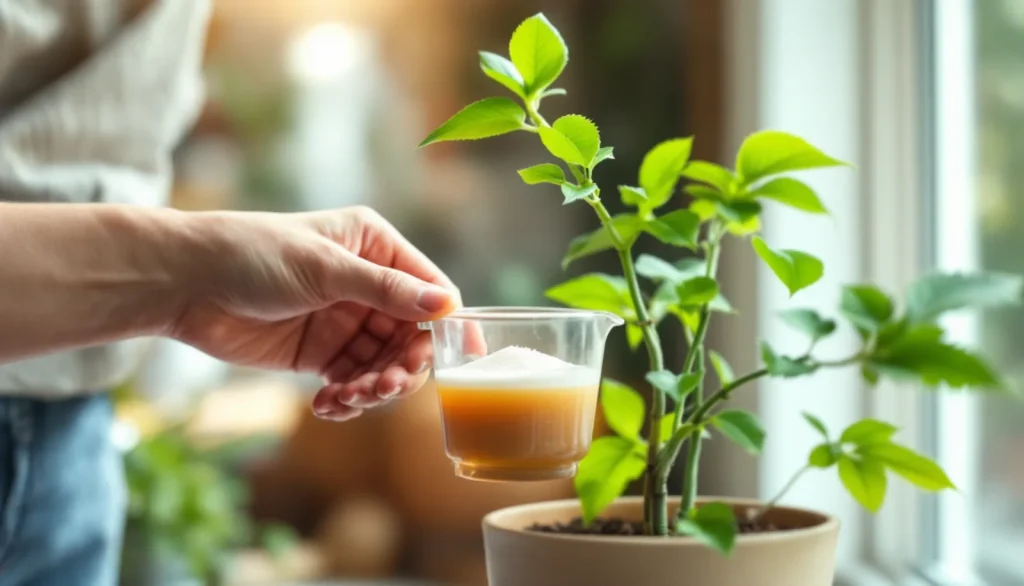
The right plant fertilizer in 2026 is almost never the bag with the prettiest label or the highest first number. It is the one with the NPK ratio that matches what your plant is doing right now, in the soil you actually have, at a release speed that does not flush growth or burn roots. This guide walks through the chemistry, the formats, the indoor versus outdoor split, and the application math, with real products and real prices, so you stop guessing in the garden center aisle.
The short version
- NPK is the three numbers on the bag: percent nitrogen, percent phosphorus pentoxide (P2O5), percent potassium oxide (K2O), by weight.
- Application rate math: pounds of product per 1,000 sq ft = 100 divided by the first NPK number. A 20-0-10 bag at 1 lb N per 1,000 sq ft means 5 lb of product.
- Granular slow-release for lawns and beds; water-soluble or liquid for houseplants and quick correction.
- Organic fertilizers (Milorganite 6-4-0, Espoma Plant-tone 5-3-3) feed soil microbes, run slower, harder to burn.
- Synthetic fertilizers (Scotts 32-0-4, Lesco 24-0-11, Yard Mastery 18-0-1) hit faster, cost less per pound of nitrogen, easier to overdose.
- Most plants want 1 to 4 lbs of nitrogen per 1,000 sq ft per year total, split across 3 to 5 applications. Tomatoes want phosphorus heavy. Lawns want nitrogen heavy.
What the three NPK numbers actually mean
Every bag of plant fertilizer in the United States carries the same three numbers in the same order. The first is nitrogen (N) by weight, the second is phosphorus reported as P2O5 (which is roughly 44 percent elemental P), and the third is potassium reported as K2O (which is roughly 83 percent elemental K). A 10-10-10 bag is 10 percent nitrogen, 10 percent phosphorus pentoxide, 10 percent potassium oxide. The remaining 70 percent is filler, micronutrients, sulfur, iron, and the carrier (urea pellet, sulfur-coated prill, polymer-coated prill, organic meal).
The three macronutrients do different jobs. Nitrogen drives leaf and blade growth, chlorophyll production, and that deep green color. Phosphorus drives root establishment, flowering, and fruit set. Potassium drives stress tolerance, disease resistance, and cold hardiness. Lawns want high N and low P, because phosphorus is already in most soils and runoff is regulated. Tomatoes want balanced N with elevated P during flowering. Houseplants in pots want a balanced gentle blend, because there is no soil reservoir to buffer mistakes. For the full breakdown of why these ratios matter and how soil reserves shift the math, see our NPK fertilizer guide.
The four formats, side by side
| Format | Best for | Release speed | 2026 cost per lb N | Burn risk |
|---|---|---|---|---|
| Granular synthetic (Scotts, Lesco, Andersons) | Lawns, large beds, trees, shrubs | Fast to 12 weeks (varies) | $1.50 to $3.50 | High if over-applied |
| Granular organic (Milorganite, Espoma, Dr. Earth) | Lawns, vegetable gardens, perennials | 4 to 8 weeks slow | $4 to $7 | Low, very forgiving |
| Liquid concentrate (Miracle-Gro, FoxFarm, Jack’s) | Houseplants, vegetables, quick correction | Immediate, lasts 1 to 2 weeks | $5 to $12 | Medium, easy to over-dilute or over-dose |
| Slow-release coated prill (Osmocote, Polyon) | Containers, nurseries, ornamentals | 3 to 9 months controlled | $8 to $14 | Very low, near impossible to burn |
How to calculate application rate
The math is the same for almost every plant fertilizer product. Take the rate the bag recommends (usually 1 lb of nitrogen per 1,000 sq ft for a lawn), divide 100 by the first NPK number, and you get the pounds of product needed per 1,000 sq ft. Scotts 32-0-4 at 1 lb N per 1,000 means 100 / 32 = 3.1 lbs of product. Milorganite 6-4-0 at the same rate means 100 / 6 = 16.7 lbs. That is why an organic lawn program costs 3x more per acre by weight, even though the nitrogen does the same biological job.
For container plants, the math flips to teaspoons or capfuls per gallon, because pots hold so little soil mass that broadcast measurements do not apply. Miracle-Gro all-purpose 24-8-16 at 1 tablespoon per gallon, applied every 1 to 2 weeks, is the baseline for nearly every houseplant. Before any lawn application, measure the area first so the math works. Our walkthrough on how to measure lawn square footage shows the smartphone, satellite, and tape methods professionals use.
Indoor versus outdoor plant fertilizer
Indoor and outdoor plant fertilizer are not interchangeable in practice, even when the chemistry overlaps. Indoor plants live in finite pots with no soil reservoir, low light, and limited evapotranspiration, so they need a much smaller dose at a higher frequency. Outdoor plants live in cubic feet of soil, get drenched by rain, and root deeper, so they tolerate a larger single dose at lower frequency.
For houseplants, water-soluble liquid concentrates (Miracle-Gro Indoor Plant Food 1-1-1, FoxFarm Big Bloom 0.01-0.3-0.7, Jack’s Classic 20-20-20) at half-strength every other watering is the default professional recommendation. For potted plants on a patio, slow-release coated prills like Osmocote Plus 15-9-12 deliver 6 months of nutrition with no follow-up. For in-ground beds, broadcast granular synthetics (Scotts All Purpose Plant Food Granules 10-10-10) or granular organics (Espoma Plant-tone 5-3-3) at spring green-up plus a midseason follow-up handles most perennials and annuals.
Trees and shrubs are the outliers. They want very little supplemental fertilizer once established. A 4 to 6 inch mulch ring with annual top-dressing of compost does more than synthetic ferts for most landscape trees, and over-fertilization is the leading cause of root death in newly planted ornamentals.
Organic versus synthetic, the honest comparison
Organic plant fertilizers (Milorganite, Espoma, Dr. Earth, Down to Earth, Sustane) are derived from natural sources: composted biosolids, alfalfa meal, feather meal, bone meal, blood meal, fish emulsion, kelp meal. They release nitrogen at 4 to 8 percent per week as soil microbes break them down, so they almost never burn and they feed the soil biology. Synthetic plant fertilizers (Scotts, Lesco, Andersons, Yard Mastery, Sunday) are derived from ammoniated phosphate, urea, ammonium sulfate, and potassium chloride. They release fast unless coated, so they hit the plant quicker, cost less, and dial in precisely, but they bypass the soil microbiome and they burn easily.
The right answer is usually both. A common pro-grade rotation is granular organic Milorganite 6-4-0 in early spring (gentle wake-up, soil-feeding), synthetic Lesco 24-0-11 with 50 percent slow-release in late spring (push growth without flush), an organic top-dress like Espoma in midsummer (microbe support during heat stress), and a synthetic late-fall winterizer 18-0-12 in October or November (deep root storage). Sardonic aside: the “all organic, no synthetics” lawn movement skips the late-fall winterizer and then wonders why the lawn is yellow every March.
Application timing by plant category
Different plants want different feeding calendars. Cool-season lawns (Kentucky bluegrass, tall fescue, perennial ryegrass) want their heaviest feed in fall, light feed in spring, no feed in summer. Warm-season lawns (Bermuda, Zoysia, St. Augustine) want their heaviest feed in late spring through summer, no feed in fall. Vegetable gardens want a moderate balanced feed at planting, a phosphorus boost at flowering, and a potassium boost at fruit set. Perennial flowers want one spring feed and one midseason top-up. Annual flowers in containers want a slow-release prill at planting plus liquid every 2 weeks. Houseplants want diluted liquid every other watering during active growth (March through October), and almost no feed during winter dormancy (November through February).
For the specific NPK picks by grass type and season, see the best fertilizer for grass guide. For the fall-specific winterizer math, see the fall lawn fertilizer guide. For vegetable gardens, see the vegetable garden fertilizer guide.
Common mistakes that kill plants
The most common plant fertilizer mistake is double-dosing. The bag says “apply 1 lb of nitrogen per 1,000 sq ft” and the homeowner assumes more is better. Nitrogen at 2 lbs per 1,000 in a single application on hot soil will burn most lawns and most ornamentals. The second mistake is wrong-format-wrong-plant: applying a high-nitrogen lawn fertilizer (32-0-4) to tomatoes, which produces gorgeous bushy plants with almost no fruit because there is no phosphorus for flowering. The third mistake is fertilizing during drought stress, when the plant cannot take up nutrients and the fertilizer salts pull water out of root tissue. If the lawn or beds are already stressed (yellowing, wilting, brown patches), water first for 2 weeks, then fertilize. Diagnosing stress before fertilizing is critical, and our guide on brown patches in lawn walks through the disease versus drought versus fertilizer-burn checklist.
The fourth mistake is ignoring soil pH. Nitrogen and phosphorus availability tank below pH 5.5 or above pH 7.5, so the fertilizer goes on but the plant cannot use it. A $15 soil test kit from any cooperative extension lab tells you pH, P, K, organic matter, and CEC, and it changes the math more than any product swap.
Where contractors buy plant fertilizer
Pro landscapers in 2026 do not buy from Home Depot for their lawn and ornamental programs. They buy from contractor distributors: SiteOne Landscape Supply, Ewing Outdoor Supply, Lesco branches. The contractor-tier bags carry higher slow-release percentages (40 to 75 percent), tighter granule size for consistent spreader throw, and pallet pricing that runs 30 to 50 percent below big-box per pound of nitrogen. A 50 lb bag of Lesco 24-0-11 with 65 percent polymer-coated slow-release runs $42 to $58 at a contractor counter in 2026; the closest big-box equivalent (Scotts Turf Builder 32-0-4, 14 lb bag) runs $24, which works out to roughly $85 per 50 lbs and contains a fraction of the slow-release nitrogen. For more on the pro-tier distribution and pricing math, see the professional lawn fertilizer guide.
FAQ
What does NPK mean on a fertilizer bag?
NPK is the three numbers on every fertilizer label: percent nitrogen by weight, percent phosphorus reported as P2O5, percent potassium reported as K2O. A 10-10-10 bag is 10 percent of each. The remaining 70 percent is filler, micronutrients, and the carrier matrix.
How often should I fertilize houseplants?
During active growth from March through October, apply a balanced liquid concentrate (Miracle-Gro 24-8-16, Jack’s Classic 20-20-20) at half-strength every other watering, which is roughly every 2 weeks. During winter dormancy (November through February), skip fertilizer entirely or feed once per month at quarter strength. Most houseplant deaths from over-fertilization happen during winter.
Is organic plant fertilizer better than synthetic?
Better for soil biology, harder to burn, slower release, more expensive per pound of nitrogen. Synthetic is cheaper, faster, more precise, easier to over-dose. The professional answer is to rotate both across the season: organic for spring and midseason feeding, synthetic for the controlled late-fall push and any quick green-up correction.
How do I know how much fertilizer to apply?
For lawns and beds, divide 100 by the first NPK number to get pounds of product per 1,000 sq ft (assuming a 1 lb nitrogen rate). A 20-0-10 bag means 5 lbs of product per 1,000 sq ft. For containers, follow the bottle label, which is typically 1 tablespoon per gallon for liquid concentrates. Measure the area first; estimating square footage by eye is off by 30 to 60 percent in most yards.
Can I use lawn fertilizer on vegetables?
No. Lawn fertilizers are high nitrogen and zero or low phosphorus (typical NPK like 32-0-4), which produces leafy growth but no fruit. Vegetable gardens want a balanced or phosphorus-heavy blend (5-10-10, 10-10-10, or 4-6-3 for tomatoes). Use vegetable-specific products like Espoma Garden-tone 3-4-4 or Dr. Earth Tomato Vegetable & Herb 4-6-3.
Bottom line
The right plant fertilizer is the one with the NPK ratio that matches what your specific plant is doing, in the soil pH you have, at a release speed your watering schedule can support. Lawns want high N, low P, slow-release. Tomatoes want balanced N, high P, organic preferred. Houseplants want diluted liquid at half-strength every two weeks during growing season. The math is simple once you internalize 100-divided-by-the-first-number, and the calendar is forgiving as long as you do not double-dose on stressed plants.
Buy from a contractor distributor like SiteOne, Ewing, or Lesco if you can open an account; the slow-release percentages and per-pound-of-nitrogen pricing are worth the trip. Big-box bags work for small properties and casual users, but they cost more per pound of actual nutrient delivered. For the seasonal application rhythms and product picks across categories, browse the rest of our learn library.