
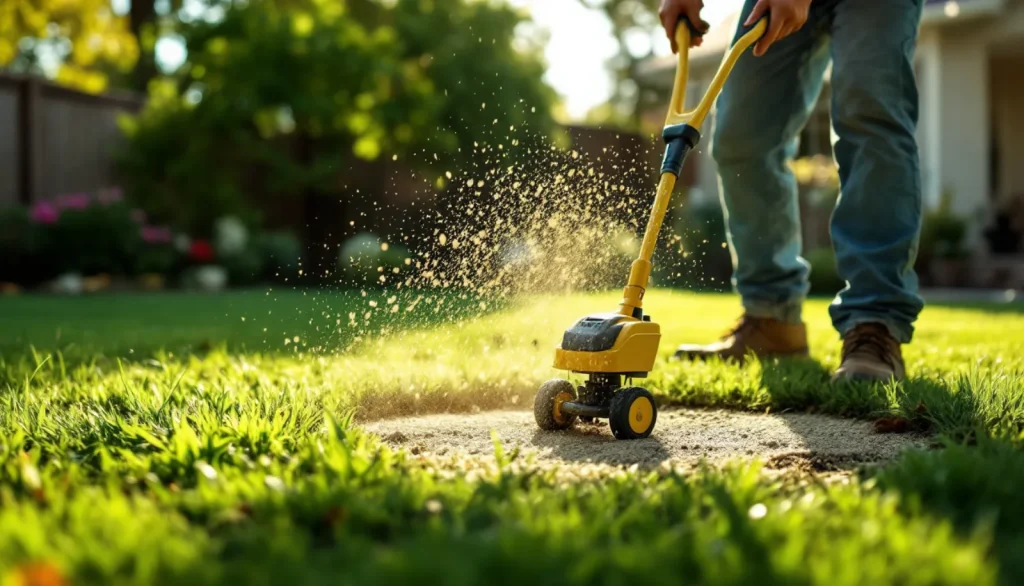
If you want to know how to make grass grow in bare spots, the answer isn’t more seed thrown harder at the dirt. Bare spots have a cause: compacted soil, dog urine, fungal damage, shade, herbicide overspray, or simple wear. Skip the diagnosis and you’ll be reseeding the same patch every April for the rest of your life. This is the 7-step renovation that works, with real material costs, actual seeding rates, and watering schedules that match what germinating seed actually needs. Total project cost for a 200 sq ft bare patch: roughly $35 to $90 in materials.
The short version
- Diagnose the cause first. Reseeding without fixing the cause is just paying twice.
- Soil prep matters more than seed brand. Loosen 2 to 3 inches deep, work in compost.
- Match seed to your zone: tall fescue or Kentucky bluegrass (cool-season), Bermuda or Zoysia (warm-season).
- Seeding rate: 6 to 8 lbs per 1,000 sq ft for tall fescue, 1 to 2 lbs for Kentucky bluegrass, 1.5 lbs for Bermuda.
- Starter fertilizer with phosphorus (Scotts Starter, Lesco 18-24-12, or similar) at 1 lb N per 1,000 sq ft.
- Water 2 to 4 times daily for 14 to 21 days, light irrigation, never let the top inch dry.
Step 1: Diagnose why the spot is bare
This is the step everyone skips and the reason bare spots come back. Walk the spot, kneel down, look at the soil, the surroundings, and the wear pattern.
| Cause | How to tell | What to fix |
|---|---|---|
| Compacted soil | Soil rings hollow underfoot, screwdriver won’t push in 4 inches | Aerate or deeply till before reseeding |
| Dog urine | Round dead spot with green ring of stimulated growth around it | Flush with water, gypsum, reseed |
| Shade | Spot is under tree canopy or north side of structure | Switch to fine fescue, or accept groundcover |
| Fungal damage (brown patch, dollar spot) | Irregular dead patches with active mycelium, often in humid weather | Fungicide first, then reseed (see brown patch diagnosis) |
| Wear path | Linear dead strip on walked route | Install stepping stones, then reseed adjacent |
| Herbicide overspray | Sharp-edged dead area near recently treated weeds or driveway | Wait out residual, replace top 1 inch of soil if needed |
| Construction damage | Buried construction debris, scraped topsoil | Excavate 6 inches, replace with topsoil/compost mix |
If the spot is shaded, no amount of Kentucky bluegrass seed will work. KBG needs 6+ hours of direct sun. Fine fescues tolerate 4 hours, sometimes 3. If the spot gets less than 3 hours of direct sun, grass is the wrong answer and you need groundcover, mulch, or a planting bed. Our problem-area grass guide covers shade, slope, and compaction solutions in detail.
Step 2: Soil prep, the part that determines everything else
Grass seed needs soil contact. It doesn’t germinate sitting on thatch, dead leaves, or compacted clay. Soil prep is 60% of why renovations succeed or fail.
Use a garden rake or thatch rake to scratch the bare spot down to bare soil. For larger areas (over 50 sq ft), rent a slit seeder ($75 to $120 day rate at Home Depot or Sunbelt) which cuts grooves and drops seed in one pass. For really compacted spots, a core aerator pass first (rent for $80 to $130 a day) pulls plugs and opens the surface.
For spots over 25 sq ft, work in 1 to 2 inches of compost (mushroom, leaf, or aged composted manure). For a 200 sq ft area at 1 inch deep, you need about 0.6 cubic yards, roughly $25 to $40 from a local landscape supply. Mix the compost into the top 2 to 3 inches of native soil with a rake. Don’t bury seed under fresh compost (more than a quarter-inch deep), it just dies down there.
Step 3: Pick the right seed for your zone
Cool-season (zones 3 to 6, and 7a in shaded areas): tall fescue (most forgiving, deep roots, 6 to 8 lbs per 1,000 sq ft). Kentucky bluegrass alone is harder to establish from seed (slow germination, 14 to 28 days) but worth it for lawns that get full sun. Perennial ryegrass germinates in 5 to 7 days and is often blended with bluegrass to give quick cover while the bluegrass establishes. Fine fescue for shade.
Warm-season (zones 7b through 10): Bermuda from seed (Yukon, Riviera, or Princess 77 cultivars are good seeded options, 1.5 lbs per 1,000 sq ft). Zoysia from seed is slow and frustrating, plug it instead. St. Augustine doesn’t come from seed at all, you sod or plug it.
Brand quality matters. Look for the bag’s blue tag (state-certified seed) with germination rate (want 85%+ for tall fescue, 80%+ for KBG), purity (98%+), and weed seed (under 0.1%). Avoid the cheapest contractor mix at big-box stores, which often contains annual ryegrass and weed seed at higher percentages. Lesco, Pennington, GCI, Hancock, and Outsidepride sell honest seed. Expect $5 to $9 per pound for quality tall fescue, $10 to $15 per pound for quality KBG.
Step 4: Starter fertilizer with phosphorus
Established lawns rarely need phosphorus. Germinating seed does. Phosphorus drives root development in the first 30 days, which is exactly when the seedling is most vulnerable. Use a starter fertilizer with an NPK around 18-24-12 or 24-25-4 or similar high-middle-number blend.
Scotts Turf Builder Starter (24-25-4), Lesco Pro Starter (18-24-12), Andersons starter blends, and Yard Mastery starter all work. Apply at 1 lb N per 1,000 sq ft (with 24-25-4 that’s about 4 lbs of product per 1,000 sq ft, so for a 200 sq ft spot, roughly 0.8 lbs of product). Some states (Maryland, Minnesota, Wisconsin, New York) restrict phosphorus fertilizer on established turf but allow it on new seedings, check the bag label for compliance. For the math behind product rates and NPK calculations, our lawn care cost guide includes application math for service estimates that homeowners can apply at DIY scale.
Step 5: Seed at the right rate and depth
Overseeding existing thin turf and bare-spot patches use different rates. For bare spots starting from soil:
- Tall fescue: 6 to 8 lbs per 1,000 sq ft (so for 200 sq ft, roughly 1.2 to 1.6 lbs of seed)
- Kentucky bluegrass: 2 to 3 lbs per 1,000 sq ft (lower because seeds are tiny)
- Perennial ryegrass: 6 to 8 lbs per 1,000 sq ft
- Bermuda (hulled, seeded cultivars): 1 to 2 lbs per 1,000 sq ft
- Fine fescue blends: 4 to 5 lbs per 1,000 sq ft
Apply with a drop spreader for precision in small areas, or a broadcast spreader for larger zones. Spread half the seed walking north-south, the other half east-west. After spreading, rake lightly to incorporate the seed into the top quarter-inch of soil, then roll with a water-filled lawn roller (rent for $15 to $25 a day) or just walk over it firmly to get good seed-to-soil contact. Seed sitting on top of soil germinates poorly because it dries out between waterings.
Step 6: Mulch protection (straw, peat moss, or covered seed)
Bare seeded soil dries out within hours on a sunny day. Mulch protects moisture and reduces washout during rain. Three options:
Clean wheat straw: cheapest, $6 to $10 per bale, covers about 400 to 500 sq ft per bale at the right thinness (you should still see 30% to 40% of soil through it). Avoid hay, which contains weed seed.
Peat moss: holds moisture better than straw, no weed seed, but more expensive. $15 to $20 per 3 cu ft bale, covers 100 to 150 sq ft at a quarter-inch depth.
Pelleted paper mulch or hydromulch: products like Scotts EZ Seed or PennMulch combine seed, fertilizer, and mulch in one. Pricier per sq ft ($0.50 to $0.80 per sq ft) but convenient. Results are inconsistent in our testing, better than nothing but not better than the soil prep plus seed plus straw approach.
Skip the mulch and you’re betting on rainfall and very frequent irrigation. If you have automated irrigation set to mist 3 to 4 times daily, you can sometimes get away mulchless. Without irrigation, mulch is not optional.
Step 7: Water like the seed depends on it (it does)
This is where most renovations fail. Germinating grass seed needs to stay consistently moist for 14 to 21 days. Not soaked, not flooded, just moist. The top half-inch of soil should never fully dry out.
Watering schedule for newly seeded bare spots:
- Days 1 to 14: light irrigation 3 to 4 times per day, about 5 to 10 minutes per session. Goal is to moisten the surface, not soak it.
- Days 15 to 21: reduce to 2 to 3 times daily, 10 minutes each. Most seedlings up.
- Days 22 to 35: 1 to 2 times daily, 15 minutes each. Push roots deeper.
- Day 35+: transition to deep, infrequent watering (1 inch per week in 2 applications).
If you don’t have an in-ground irrigation system, this means dragging a hose and oscillating sprinkler 3 to 4 times a day for 2 to 3 weeks. A simple Toro or Rain Bird hose timer ($25 to $50) makes this tolerable. For permanent zones being installed at the same time, drip irrigation works for groundcovers but spray heads are needed for turf, so see our drip irrigation guide for bed-side install techniques alongside lawn zones. To calculate watering volume by lawn area, the square footage measurement guide covers methods.
What to expect by week
Week 1: nothing visible. The seed is imbibing water. Don’t dig around to check, you’ll bury or expose seed.
Week 2: perennial ryegrass germinates around day 5 to 7. Tall fescue around day 7 to 14. Kentucky bluegrass around day 14 to 21. If you seeded a blend, ryegrass shows first.
Week 3 to 4: first mowing when blades reach 3.5 to 4 inches. Mow at 3 inches with a sharp blade. Bag clippings the first 2 mows to avoid smothering new seedlings.
Week 5 to 8: apply second round of fertilizer at half-rate (around 0.5 lb N per 1,000 sq ft) using a balanced lawn food like 24-0-12 to push tillering. Avoid weed control products in this window (most pre-emergents and post-emergents are toxic to seedlings under 6 weeks old, check the label).
Week 10 to 12: lawn essentially established. Resume normal mowing height (3.5 to 4 inches for tall fescue, 2.5 to 3 inches for KBG, 1 to 2 inches for Bermuda). For diagnosis of any patches that don’t fill in or develop fungal issues during establishment, the brown patches guide covers next-step troubleshooting.
Real cost: a worked example for a 200 sq ft bare patch
| Item | Quantity | Cost |
|---|---|---|
| Tall fescue seed (Lesco quality) | 1.5 lbs | $11 |
| Starter fertilizer (24-25-4) | 5 lb bag (have leftover) | $18 |
| Compost (delivered) | 0.5 cu yd | $30 |
| Straw mulch | 0.5 bale | $5 |
| Tool rental (rake, roller for half day) | 1 | $15 |
| Total | ~$79 |
Compare to hiring a lawn renovation service: $200 to $400 minimum for a service visit to address 200 sq ft, and they typically use the same materials. For DIY-able bare spots under 500 sq ft, doing it yourself wins. For full lawn renovations over 2,000 sq ft, the calculus changes (more on this in our DIY vs lawn repair service comparison).
FAQ
What is the best time of year to reseed bare spots?
For cool-season grasses (tall fescue, KBG, ryegrass), late summer to early fall (August 15 to October 15 in most of the country) is best. Soil is warm, air is cooling, weed pressure is low. Spring (April to mid-May) is the second-best window. For warm-season (Bermuda), late spring to early summer (May to June) when soil hits 65°F.
Should I use a starter fertilizer with weed preventer?
No. Most “starter plus weed preventer” products (like Scotts Turf Builder Starter Plus Crabgrass Preventer with Mesotrione) work for newly seeded areas, but never combine seeding with prodiamine, dithiopyr, or other pre-emergents not specifically labeled safe for new seed. Read the label. Mesotrione (Tenacity) is the one pre-emergent considered safe at seeding.
How much will rain wash my seed away?
A light rain is fine. A heavy rain on bare soil washes seed downhill. The straw or paper mulch step protects against this. On steep slopes (over 4:1), use erosion blanket (Jute or coir netting, $0.25 to $0.50 per sq ft) stapled in place over the seed.
Can I just throw down some Scotts EZ Seed and call it a day?
You can, and for spots under 10 sq ft it sometimes works. The reason it fails more often than not is that the convenience product replaces every step except watering, which means soil prep is still terrible underneath. Scratch the surface first, even just with a hand rake, and EZ Seed works much better.
My dog keeps killing spots in the same area. How do I stop it?
The dog won’t change. Solutions in order of effectiveness: train the dog to use a specific gravel or mulch area (works), flush spots with water within 8 hours of urination to dilute (helps), feed the dog more water to dilute urine (small effect), specialty supplements like Green-UM (mixed results). For the patch itself, flush thoroughly with 1 to 2 gallons of water, apply gypsum (1 lb per 100 sq ft) to displace salts, wait 7 to 10 days, then reseed using the 7-step process.
Bottom line
Making grass grow in bare spots is not complicated, but the order matters and the watering schedule matters most. Diagnose the cause, prep the soil to bare earth, match seed species to your zone and sun exposure, use a starter fertilizer with phosphorus, seed at the correct rate with seed-to-soil contact, mulch lightly, and water 3 to 4 times daily for the first two weeks.
Skip any of those and the result is the same patchy outcome that drove you to read this article. For under $100 in materials and 30 minutes of weekly attention through establishment, a 200 sq ft bare patch becomes indistinguishable from the surrounding lawn by week 10. For problem areas where grass refuses to grow even with this process (deep shade, slopes, severely compacted soil, pet damage), the problem-area guide covers species selection beyond the standard seed list. For comparing this DIY approach to hiring a lawn repair service, see the service vs DIY breakdown. The learn hub indexes the rest of the lawn care playbook.