
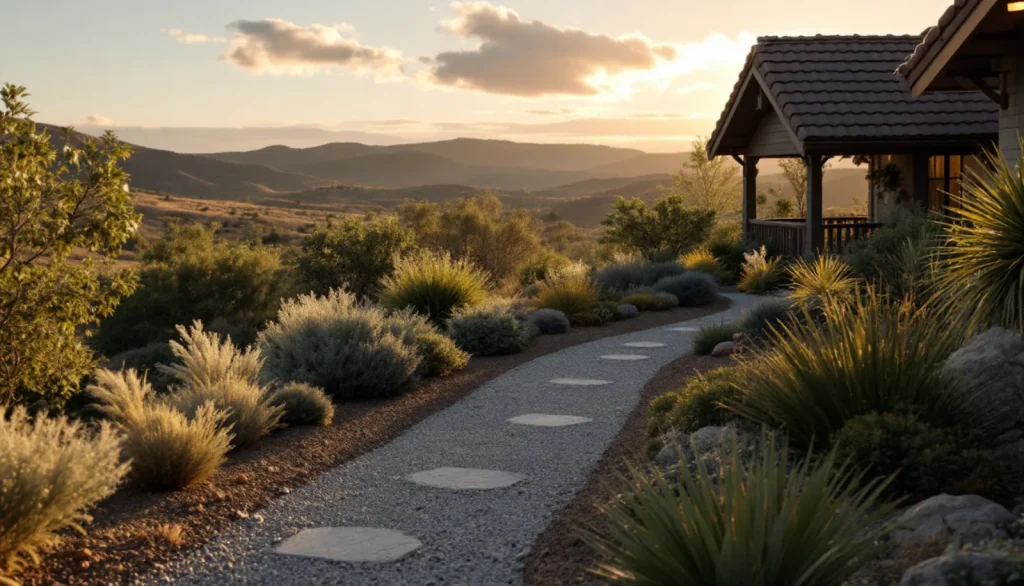
The Cal Fire defensible space zones framework, codified in California Public Resources Code section 4291 and the implementing 14 CCR section 1299 regulations, is the wildfire-landscape code that is now reshaping how every yard inside California’s State Responsibility Areas and Very High Fire Hazard Severity Zones gets designed, planted, and maintained. The three-zone structure (Zone 0 ember-resistant, Zone 1 lean-clean-green, Zone 2 reduce-fuel) sets non-negotiable rules on combustible vegetation, mulch, fence material, and tree spacing inside 100 feet of every structure.
The short version
- Cal Fire Public Resources Code 4291 requires defensible space inside 100 feet of structures in State Responsibility Areas and very high fire hazard zones.
- Zone 0 (0 to 5 feet, ember-resistant): no combustible vegetation, no bark mulch, no overhanging branches, hardscape and gravel only. Required for new construction since January 1, 2025.
- Zone 1 (5 to 30 feet, lean-clean-green): well-irrigated low-flammability plants, removed deadwood, separated shrubs.
- Zone 2 (30 to 100 feet, reduce fuel): horizontal and vertical fuel separation, removed ladder fuels, spacing rules.
- Enforcement runs through Cal Fire defensible space inspectors plus local fire authorities, with insurance carriers now using compliance status as an underwriting input.
What the zones actually require
The Zone 0 rule is the strictest and the newest. Under 14 CCR 1299.03, Zone 0 covers the first 5 feet from the structure (or any attached deck) and prohibits combustible vegetation, combustible mulch (bark, wood chips, rubber mulch), combustible fencing within 5 feet of the structure, stored combustible materials (firewood, propane tanks), and overhanging tree branches. Permitted Zone 0 ground cover is gravel, decomposed granite, concrete pavers, or bare mineral soil. Permitted vegetation is limited to specific low-flammability ground covers approved by Cal Fire and the Office of the State Fire Marshal.
The Zone 0 requirement took effect for new construction on January 1, 2025. The compliance deadline for existing structures is being phased in by parcel category, with the highest-risk Very High Fire Hazard Severity Zones first. The current best-available date for existing single-family compliance is January 1, 2026, though local fire authorities have discretion to extend or accelerate the timeline.
Zone 1 covers 5 to 30 feet from the structure. The rule is lean, clean, and green. Vegetation is permitted but must be low-flammability, well-irrigated, and well-maintained. Deadwood, dead leaves, and pine needles must be removed from the ground and from gutters. Shrubs must be spaced to prevent fire spread between plants. Tree canopies must be limbed up at least 6 feet from the ground and kept 10 feet apart from each other and from the structure.
Zone 2 covers 30 to 100 feet. The rule is fuel reduction. Horizontal and vertical separation between shrubs and trees is required to break the fire-spread continuity. Ladder fuels (vegetation that can carry a ground fire up into a tree canopy) must be removed. Tree-to-tree spacing requirements are graduated based on slope, with steeper slopes requiring wider spacing.
Why the rule reshaped California landscape design
The defensible space rule, especially the Zone 0 piece, made entire categories of landscaping non-compliant overnight. The classic California front yard with foundation plantings of juniper or rosemary running up to the stucco is now a Zone 0 violation. Wood-chip mulch in the first five feet is a violation. The wooden side-gate that meets the house is a violation. Even a row of potted plants on the front porch can be a violation depending on the plant material and the pot construction.
The downstream effect on the landscape industry has been a complete rework of the standard residential front-yard template inside the affected zones. The new template runs gravel or pavers in the first 5 feet, low-flammability ground cover from 5 to 30 feet, and managed tree-shrub spacing from 30 to 100 feet. Native plant nurseries have built dedicated Zone 1 and Zone 2 plant palettes. Landscape designers have added Cal Fire compliance review to the standard residential design package.
By the numbers
| Zone | Distance from structure | Key rules |
|---|---|---|
| Zone 0 (Ember-Resistant) | 0 to 5 feet | No combustible vegetation, no bark mulch, no overhanging branches, hardscape and gravel only |
| Zone 1 (Lean, Clean, Green) | 5 to 30 feet | Low-flammability plants, well-irrigated, deadwood removed, shrubs separated |
| Zone 2 (Reduce Fuel) | 30 to 100 feet | Horizontal and vertical fuel separation, ladder fuels removed, tree spacing per slope |
Insurance has made this real
The bigger lever forcing compliance has been the California homeowner insurance market, not Cal Fire enforcement directly. State Farm, Allstate, Farmers, USAA, and the smaller California-only carriers have all introduced wildfire-risk underwriting models that weigh defensible space compliance as a significant input. The Insurance Commissioner’s Safer From Wildfires framework, finalized in 2022 and updated through 2025, requires admitted carriers to recognize defensible space compliance, home hardening, and community-level mitigation in their underwriting and pricing.
The practical effect is that homeowners in the affected zones cannot get a renewal quote unless their property passes either a self-attestation or an in-person defensible space inspection. The California FAIR Plan, which is the insurer of last resort, has its own defensible space requirements that apply to every policy it writes.
For landscape operators in California, that translates to a steady book of defensible space remediation work driven by homeowners who cannot renew insurance without it. The job ticket runs $3,500 to $18,000 for a typical single-family remediation, depending on tree work, hardscape conversion, and irrigation rework.
What operators and homeowners should do
For operators, the path is to add defensible space inspection and remediation as a service line, get crew leads through Cal Fire’s defensible space training where available, and build a template estimate that walks the homeowner zone by zone. Get familiar with the Cal Fire approved plant lists by region (Northern, Central, Southern California have separate recommended palettes). Photo-document every job for the homeowner’s insurance file, because the homeowner will need that documentation at the next renewal cycle.
For homeowners, the path is to walk the property with the three zones in mind. Pull out the bark mulch in the first 5 feet. Remove combustible vegetation from Zone 0. Limb up tree canopies in Zone 1 and Zone 2. Document everything with photos. Then either submit the self-attestation to the insurance carrier or schedule an inspection through Cal Fire or the local fire authority.
For broader landscape context, see our coverage of drought-tolerant lawn alternatives (most Zone 1 and Zone 2 plant palettes are drought-tolerant by design), the California MWELO ordinance, the California turf removal rebate, and the yard design guide for redesigning a front yard from scratch.
Background: why California finally wrote Zone 0
California’s defensible space law has existed in some form since the 1960s, but the original PRC 4291 rule was a single 100-foot defensible space zone with general fuel-reduction language. The post-2017 wildfire seasons (Tubbs, Camp, Thomas, Caldor, Dixie, Park) made clear that the highest-risk ignition point on most residential structures was not the 100-foot perimeter but the 5-foot ember-deposition zone immediately against the wall. Ember showers from approaching wildfires accumulate in the first 5 feet, ignite the mulch or vegetation, and then climb into the siding.
The Insurance Institute for Business and Home Safety (IBHS) published structural-survival research showing that the 0-to-5-foot zone was the single most consequential point for hardening a structure. AB 3074, passed in 2020, directed the State Board of Forestry and Fire Protection to write the Zone 0 rule. The implementing 14 CCR 1299 regulations were finalized in 2024 and took effect for new construction on January 1, 2025.
FAQ
Does the rule apply to my house?
If your house is in a State Responsibility Area or a Very High Fire Hazard Severity Zone (a Local Responsibility Area VHFHSZ), yes. Cal Fire publishes a parcel-level lookup map. Many counties also publish their own maps with local hazard overlays.
Can I still have a lawn in Zone 1?
Yes, as long as it is well-irrigated and well-maintained. A green lawn is one of the lower-flammability ground covers available. The issue is a dead or dormant brown lawn, which becomes Zone 1 fuel.
What about my wood fence?
A wood fence that connects directly to the structure within the first 5 feet is a Zone 0 problem because it carries fire to the wall. The standard remediation is to install a non-combustible gate or break in the first 5 feet, with the wood fence continuing past that point.
Does artificial turf count as a combustible material?
Artificial turf is not currently prohibited in Zone 0 under the state rule, but local jurisdictions may restrict it. The petroleum content does ignite and several local fire authorities have moved against it in Zone 0.
How is this enforced?
Cal Fire defensible space inspectors, local fire authorities, and insurance company inspectors all run independent compliance checks. Penalties for non-compliance can include fines, but the bigger consequence is insurance non-renewal, which has hit thousands of California homeowners over the past three years.
Bottom line
The three-zone defensible space framework is the most consequential wildfire landscape rule in the country, and it has driven a complete redesign of the residential front yard in California’s fire-affected zones. Homeowners and operators who treat this as an insurance-driven business reality, not just a Cal Fire enforcement item, will navigate the next five years with the least friction. For the broader regulatory picture, see our regulatory hub and the market research series.